|
|
|
|
This section contains the following topics: |
Web services are self-describing modular applications that enable distributed computing over the Internet. Web services can provide anything from simple information requests to complicated business processes. Web services can be published, located, and invoked remotely across the Web.
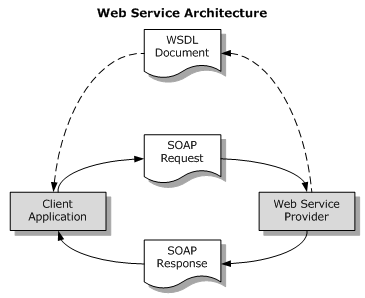
Web service interfaces provide enough detail to allow the development of calling applications. This interface is typically described in an XML document named a Web Services Description Language (WSDL) file. Web service messages are defined using the SOAP protocol, and are conveyed using HTTP.
Software applications written in different programming languages and running on various platforms can all use web services to exchange data and processes. This interoperability (for example, between Microsoft Windows and Linux applications) is possible because web service architecture is based on accepted open standards.
The web services protocols are used to define, locate, implement, and make web services interact with each other. The following XML-based protocols specify the web service interface as required by CA Identity Manager:
Defines the run-time message format that contains the service request and response.
Describes the web service interface, the SOAP message, and how the service is invoked.
A web service can be thought of as a software service described in a WSDL document and formatted on the Web in a SOAP document. This relationship is illustrated in the following diagram: