

In a domain implementation, the domain manager controls the distribution of software to one or more agents. The domain manager and the computers networked to that manager comprise a domain. Typically, in a domain implementation, agents are based at the same site and connected to the manager over a local area network (LAN), as shown in the following illustration:
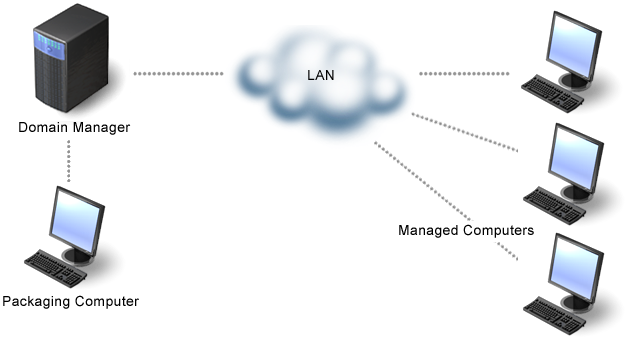
When the domain manager functions without an enterprise manager, it is referred to as an autonomous (stand-alone) domain manager.
Using an autonomous domain manager works well when all managed computers are connected to the same logical network and the total number of participating computers is within the limit permitted, as determined by the size of the manager. In such a situation, this setup avoids unnecessary infrastructure and hardware, while preserving the benefits of manageability and uniformity offered by the software delivery functionality.
If your organization has more than one domain, using an autonomous domain structure at each site bypasses the centralized control offered by having an enterprise manager connected to several domains. Domain managers cannot use software delivery functionality to distribute software to each other.
|
Copyright © 2013 CA.
All rights reserved.
|
|