

A medium-sized fresh-food manufacturer has a few hundred employees, with four (4) major offices spread across North America. Three (3) of their offices are in the United States (Boston, New York, and Portland, Oregon) and one is in the Canadian city of Vancouver. About 75 to 100 employees work in each of these offices. The company also has a smaller satellite office in Austin, Texas, that joined the company through a recent acquisition. About 20 to 30 people work in the Austin office.
The main branch is located in New York, and it also serves as the company's headquarters. The enterprise manager is located here, enabling central management of all aspects of the business and monitoring of all the branches.
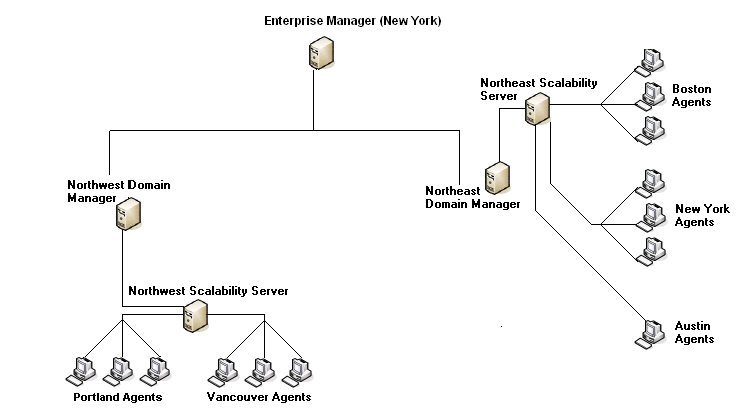
Although the four offices are geographically distant, they fall into two distinct regions. The Boston and New York offices are both in the Northeast region of America, while the Portland and Vancouver offices are both in the Northwest. So, a decision was made to place one scalability server and one domain manager in each region. The two scalability servers and domain managers manage the day-to-day tasks of both of their respective branches.
Each region would have its own domain administrator, who would deploy the asset management agent on the computers in their network, create security profiles and specify who can access the DSM Explorer and to what extent and oversee the effective utilization of the IT assets. The administrator is also responsible for troubleshooting problems using the DSM Explorer on the regional domain manager.
The administrator or any other user with appropriate rights would do the following asset management specific configurations to suite your business requirement:
The only remaining question is, what do you do about Austin? It does not fall neatly into either region. Should those employees use the scalability server on the west coast, or the east coast? Or should Austin have its own scalability server, domain manager, and domain administrator?
The deciding factor is the number of users who will be connecting to the scalability server. Since there are only about 30 employees in the Austin office, it probably does not need to have its own scalability server. Instead, the Austin employees can send their data to the scalability server that has the fewest users.
If the needs of the employees increase, another scalability server can be added, either in Austin, or in one of the two main regions. Since CA ITCM is completely scalable, additional scalability servers and domain managers can be added as needed. The scalable multi-tier architecture of CA ITCM can accommodate any size organization, large or small. The architecture is robust, as all asset inventory information is managed at each domain manager location.
The entire architecture is controlled by the enterprise manager that replicates the data from and to the domain managers. It can push jobs and policies that must be run on all the computers in the domain.
The following graphic depicts how the asset management architecture might be implemented in the fresh-food manufacturing company:
Note: For more detailed information about implementing asset management, see the Implementation Guide.
|
Copyright © 2013 CA.
All rights reserved.
|
|