

MDB Deployment › Multiple MDBs
Multiple MDBs
Multiple MDB instances may be needed for reasons of size, legal requirements, organizational structure, or geography. In addition, organizations may need to deploy one or more MDBs in IT environments that include non-CA Technologies software solutions.
The MDB enables a federated approach that uses multiple databases or data instances. To gain a single integrated view, data must be retrieved or accessed from multiple data instances as shown in the following illustration. Supporting multiple MDBs may require additional planning and administration.
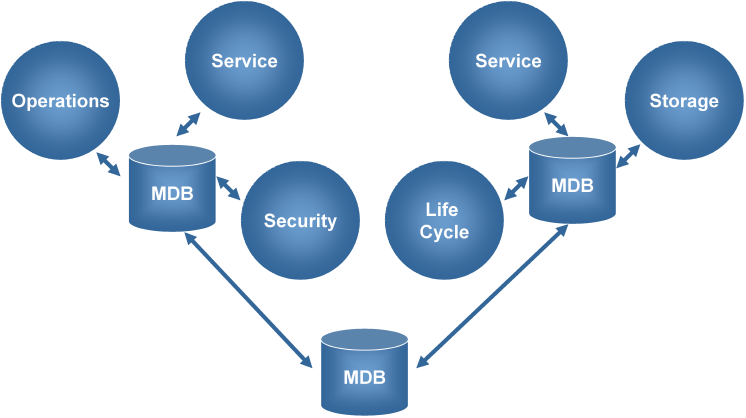
In this scenario, one or more products access different MDBs. Each of the following approaches provides a single integrated view (for reporting purposes) of the underlying IT infrastructure:
- Distributed query support, provided by the relational database being used, enables a federated approach. With distributed query, multiple MDBs, each with their own management information, are segmented and implemented by function/geography and organization. Distributed queries allow data from different databases (MDBs) to appear as if it were from one database.
- Replication, available by the relational database being used and built into some of CA Technologies's management products directly, enables a federated approach. With replication, each function/geography or organization uses its own MDB for management information. Data from each MDB is replicated to a central database server with an MDB that provides a single, integrated view of the company's IT infrastructure. In a replicated approach, the central database server might also serve as an MDB supporting one or more CA Technologies products.
Copyright © 2008 CA.
All rights reserved.
|
|