

Group inheritance allows principals to inherit rights as the result of group membership. Group inheritance proves especially useful when you organize all of your users into groups that coincide with your organization's current security conventions.
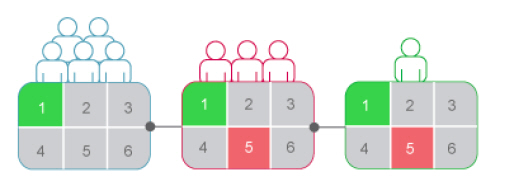
In Group inheritance example 1, you can see how group inheritance works. Red Group is a subgroup of Blue Group, so it inherits Blue Group's rights. In this case, it inherits right 1 as granted, and the rest of the rights as unspecified. Every member of Red Group inherits these rights. In addition, any other rights that are set on the subgroup are inherited by its members. In this example, Green User is a member of Red Group, and thus inherits right 1 as granted, rights 2, 3, 4, and 6 as not specified, and Right 5 as denied.
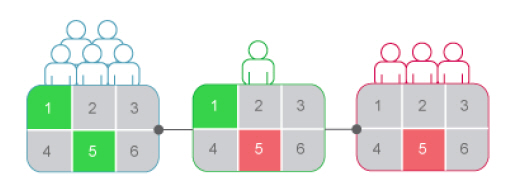
When group inheritance is enabled for a user who belongs to more than one group, the rights of all parent groups are considered when the system checks credentials. The user is denied any right that is explicitly denied in any parent group, and the user is denied any right that remains completely not specified; thus, the user is granted only those rights that are granted in one or more groups (explicitly or through access levels) and never explicitly denied. In Group inheritance example 2, Green User is a member of two unrelated groups. From Blue Group, he inherits rights 1 and 5 as granted and the rest as not specified; however, because Green User also belongs to Red Group, and Red Group has been explicitly denied right 5, Green User's inheritance to right 5 from Blue Group is overridden.
|
Copyright © 2010 CA.
All rights reserved.
|
|