

Software Management in the CA IDMS Environment › CCDB Change Management Functions
CCDB Change Management Functions
As a central repository, the Change Control Database contains information that can be used to produce reports for project monitoring, workflow analysis, resource allocation, productivity analysis and project planning.
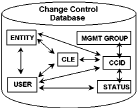
The categories of information in the CCDB that are used when performing change management are: Change Control Identifiers, Management Groups, Status Codes and Security Classes.
- Change Control Identifiers (CCIDs) – CCIDs are optional identifiers that combine one or more Change Log Entries (CLEs) into groups for purposes of control, security or reporting. A CLE can be related to more than one CCID. CCIDs are associated with either programmers or entities in the CCDB, and this association must precede dictionary update. When the update occurs, CA Endevor/DB then automatically relates each entity update performed by a user to the associated CCID. CCIDs can be used as selectors for entity promotion.
- Management Groups – These are user-defined identifiers that group one or more related CCIDs. Information stored in a Management Group includes the Management Group name and a user-defined description of the relationship between the CCIDs it manages. For example, a Management Group called "Release 2.0" might stand for all the changes needed for the next release of a system. A CCID can participate in any number of Management Groups. And like CCIDs, Management Groups can be used as selectors for entity promotion.
- Status Codes – These are optional user-defined values that can be used for many purposes in the change control cycle such as workflow tracking, project reporting or entity promotion. Typically, an installation will define Status Codes that represent milestones in the development and implementation cycle such as coding, testing, quality assurance or production migration. Status values can be associated within the context of a CCID. This capability allows a shared entity to have a unique status for each project to which the entity belongs. Online and offline reports summarize all entities associated with a particular status.
- Security Classes – Security classes control access to data dictionary entities and CA Endevor/DB functions. A security class can be associated with a user, dictionary or CCID. Typically created once per job function or project, the Security Class can be associated with any number of users or CCIDs. Each CA Endevor/DB user and CCID is associated with a Security Class. When a user is added automatically by the Dynamic Change Monitor, a default Security Class is assigned.
An important function of the Dynamic Change Monitor is to automatically associate Change Control IDs with a user's work in a particular data dictionary. This action is performed implicitly by the Dynamic Change Monitor by accessing the user's profile contained in the CCDB to obtain the current CCIDs for that individual, or by accessing the entity's profile in the CCDB to obtain the current CCIDs for that entity. From that point forward, all Change Log Entries (CLEs) in the CCDB for that individual or entity will be associated with the CCIDs obtained.
From the standpoint of Change Management, the benefits derived from the automatic association of CCIDs to work performed in a dictionary are numerous. This capability enables managers to examine the data dictionary entities modified for an individual project or for a group of programmers sharing the same CCID. Additionally, the CCID can be used as a selection criterion to identify the minimum set of dictionary entities to be promoted from testing to quality assurance or production.
Copyright © 2013 CA.
All rights reserved.
|
|