

Determining How an Entity Should Be Stored › Graphic Conventions › Conventions for Specifying Location Mode
Conventions for Specifying Location Mode
To indicate your location mode decision on the data structure diagram, you need to name the method (CALC or CLUSTERED). If the entity is to be stored CALC, name the CALC key. If the entity is to be clustered, name the relationship or the index it is to be clustered around.
The diagram below shows how your location method decisions are indicated on the diagram. The EMPLOYEE entity has a location mode of CALC. Its CALC key is the data element EMP ID and duplicates of this key are not allowed; the key must be unique. The second example is the DENTAL CLAIM entity, which has a location mode of CLUSTERED. Occurrences of this entity will be clustered around the COVERAGE-CLAIMS relationship.
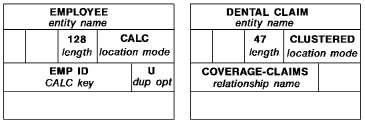
The following characteristics of the entities are indicated on the diagram:
- Entity name— The name of the entity
- Length— The estimated data length (in bytes) for fixed-length entities; the maximum length for variable-length entities. This information is used in database sizing.
- Location mode— How the entity is stored in the database (CALC or CLUSTERED).
- CALC-key, relationship name, or index name—The name of the CALC-key field (CALC entities) or the name of the relationship around which this entity is to be clustered (if the entity is to be clustered around a relationship), or the name of the index around which this entity is to be clustered (if the entity is to be clustered around an index).
- Dup opt (CALC entities only)—The duplicates option: the disposition of entities with duplicate CALC keys (U for unique or blank for non-unique).
Copyright © 2014 CA.
All rights reserved.
|
|