

Types of Ready Modes
A transaction can restrict runtime operations in a database area by readying that area with a mode of update or retrieval, as follows:
|
Type |
Description |
|---|---|
|
Update |
The readying transaction can both retrieve and update data within the area. |
|
Retrieval |
The readying transaction cannot update data in the area. |
Ready Mode Qualifiers
You can qualify the specified area ready mode with a shared (default), protected, or exclusive option to prevent update or retrieval of an area by other transactions executing concurrently under the same central version or, in the case of a shared area, under other central versions that are members of the same data sharing group. The qualified ready modes are:
|
Ready Mode |
Description |
|---|---|
|
Shared update |
If a transaction has readied the area in shared update mode, other transactions executing concurrently can ready the area in shared update or shared retrieval mode. |
|
Shared retrieval |
If a transaction has readied the area in shared retrieval mode, other transactions executing concurrently can ready the area in shared update, shared retrieval, protected retrieval, or protected update mode. |
|
Protected update |
If a transaction has readied the area in protected update mode, other transactions executing concurrently can ready the area in shared retrieval mode only. |
|
Protected retrieval |
If a transaction has readied the area in protected retrieval mode, other transactions executing concurrently can ready the area in shared retrieval or protected retrieval mode. |
|
Exclusive update and exclusive retrieval |
If a transaction has readied the area in exclusive update or exclusive retrieval mode, other transactions executing concurrently cannot ready the area in any mode. Exclusive retrieval is available only using navigational DML. |
|
Transient retrieval |
A ready mode of transient retrieval cannot be explicitly set by application programs or access module specifications. Instead, transient retrieval is automatically used by a transaction accessing an area in a retrieval mode, if either of the following conditions apply:
If a transaction has readied an area in transient retrieval mode, other transactions executing concurrently can ready the area in any mode. |
Note: Both area status and transaction isolation levels area discussed under 39.2.2, "Central Version Area Status" and 39.2.4, “Ready Modes and SQL Access”, respectively.
Compatibility of Ready Modes
The mode in which one transaction readies an area restricts the mode in which other transactions executing under the same central version or in the case of a shared area, within the same data sharing group, can ready that area. This table shows the modes in which transaction B can ready an area, depending on the mode in which transaction A has readied the area. Y(es) signifies that the second transaction can ready the area in the specified mode; N(o) signifies that it cannot.
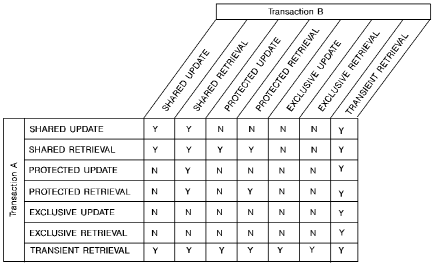
Concurrent Use of an Area Within a Central Version or Data Sharing Group
When a transaction cannot ready an area because of a protected or exclusive restriction, CA IDMS/DB places the transaction in a wait state. When the restriction is lifted, the transaction can proceed.
Example of Concurrent Area Usage
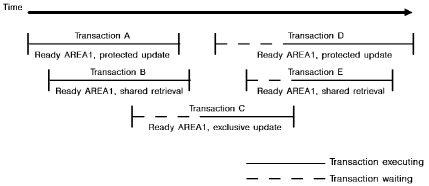
The following diagram shows concurrent use of an area by transactions executing under a central version or data sharing group. Concurrently, transaction A readies AREA1 in protected update mode, transaction B readies the area in shared retrieval mode, and transaction C attempts to ready the area in exclusive update mode. The system puts transaction C into a wait state until both transactions A and B terminate. Transactions D and E, attempting to ready the area, must wait until transaction C terminates.
|
Copyright © 2014 CA.
All rights reserved.
|
|