

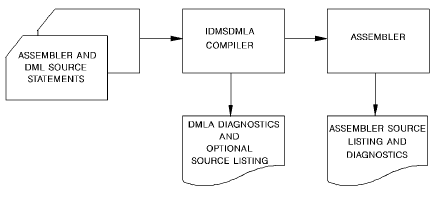
An Assembler source program that contains DML statements is processed by the DML precompiler (IDMSDMLA) before it is submitted to the assembler. The DML precompiler performs the following functions:
An Assembler program must be submitted to the DML precompiler if the program contains any of the following statements:
If none of these statements is included, the Assembler program can bypass the DML precompiler. The source can be submitted directly to the assembler because most Assembler DML statements are macro instructions that are expanded during assembly. It is recommended, however, that all programs accessing the database or running under a DC/UCF system use the DML precompiler. For a list of Assembler DML macros, see the Assembler DML Macros and Error Messages.
Output from the DML precompiler is a card-image source file that serves as input to the assembler. Output from the assembler consists of an object program and a source listing that includes any generated diagnostics. During assembly, most procedural DML verbs are expanded into executable Assembler source code, whether or not the DML precompiler was executed.
After the program is assembled, it is submitted to the linkage editor. The linkage editor link edits the object program into a specified load library. Output from the linkage editor consists of a load module and a link map.
The following figure illustrates the steps involved in assembling and executing an Assembler program containing DML statements.
|
Copyright © 2014 CA.
All rights reserved.
|
|