

As information requirements become increasingly complex, organizations need to find new ways to distribute processing power, application programs, and data. Distributed data processing allows distribution of application programs and data among interconnected sites to satisfy the information needs of the organization. Depending on its requirements, an organization may choose to centralize or decentralize its data processing systems.
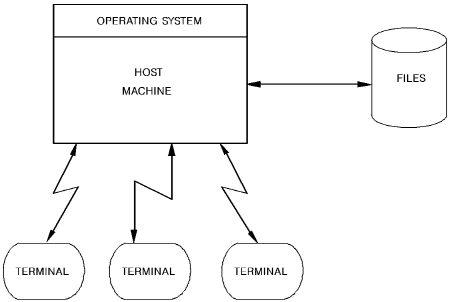
In a centralized system, one machine controls all file access and updates.
A centralized system responds to the needs of the organization by permitting a high level of control over application programs and data.
A centralized data processing system is useful when:
In a centralized data processing environment, more attention typically is given to direct access storage devices (that is, their cost and reliability) than to data transmission.
The following illustration shows the way in which one machine controls all file access and updates in a centralized system.
In a decentralized system, multiple machines control file access and updates to serve the varied needs of end users.
End users tend to have more control over application development and operations in a decentralized environment. A decentralized system is useful when:
In a decentralized data processing environment, more attention typically is given to data transmission costs and reliability than to direct access storage devices.
Distributed data processing networks make it possible to combine the benefits of both centralized and decentralized systems. These networks can be viewed in two ways:
CA IDMS DDS is designed to respond to the need for distributed processing. The remainder of this chapter presents an overview of concepts and network configuration.
|
Copyright © 2013 CA.
All rights reserved.
|
|