

Work File Usage for SECALLOC Step:
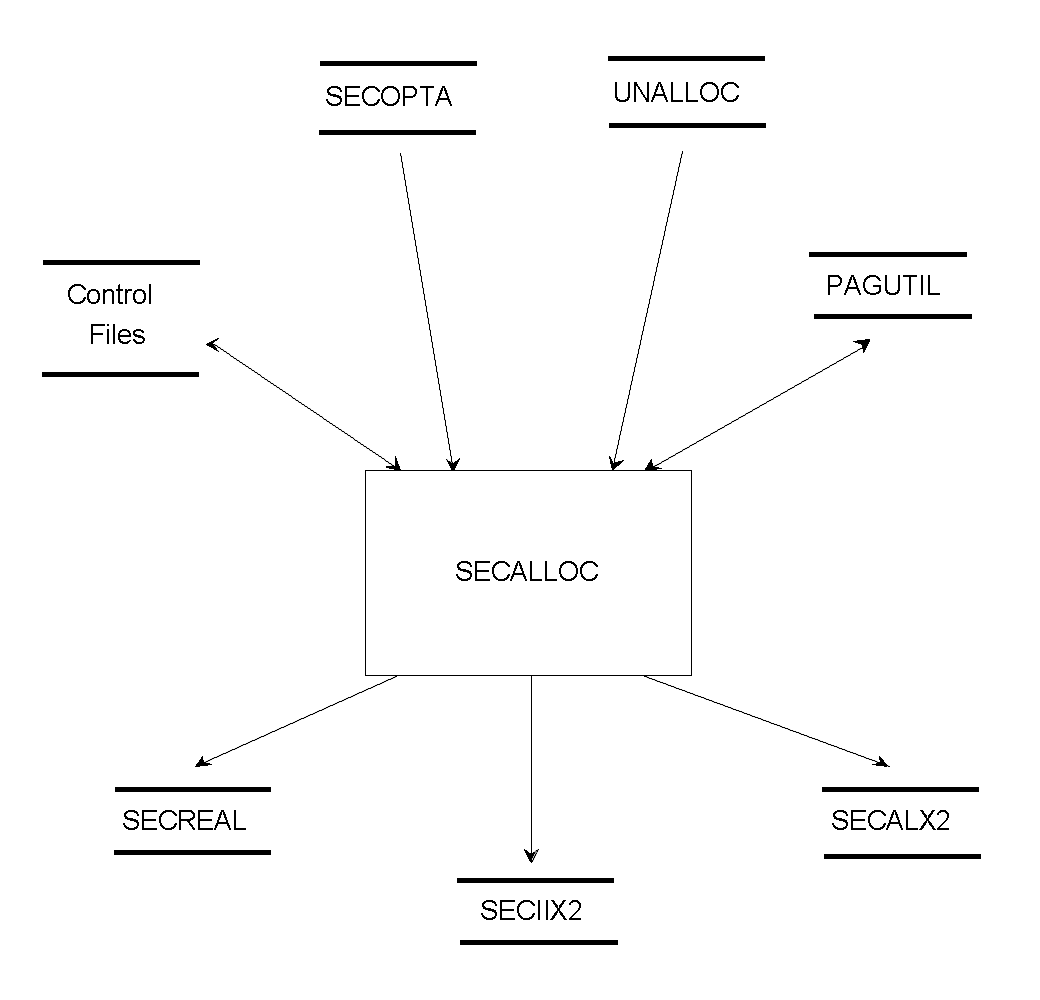
Estimating Space for Work Files (SECREAL):
|
Work File(s) |
REC FM |
LRECL |
BLKSIZE |
Space Allocation |
|---|---|---|---|---|
|
SECREAL |
FB |
22 |
6138 |
# of SECREAL records = (# of SECOPTA records) + (# of UNALLOC records) + (# of SR8 records created) + (# of entries in the BL SR8) + (# of entries for UL SR8's - sets sorted by DBKEY only) Note: This calculation must be done for each indexed set in the area. BL - Bottom Level UL - Upper Level |
Recap
  Number of records for each indexed set in the area =
  number of SECOPTA records
+
  number of UNALLOC records
+
  number of of SR8 records created
+
  number of entries in bottom level SR8 records
+
  (if sorted db-key) number of entries in upper level SR8 records.
The space needed because of SR8 (integrated index) records will never exceed one SECREAL record for each of the SR8s and bottom level entries in the existing database, plus (if sorted by db-key) the number of entries in the upper levels. These figures can be obtained from the CA IDMS/DB Analyzer report, SR8 Index Statistics Section: Upper Level--SR8 Records Bottom Level--SR8 Records Bottom Level-- Used Table Entries and if sorted db-key, Upper Level--Used Table Entries
You can use that total of records or do a more detailed calculation as shown in For SECREAL and SECALX2 (optional detailed calculation).
Estimating Space for Work Files (SECALX2, SECIIX2):
|
Work File(s) |
REC FM |
LRECL |
BLKSIZE |
Space Allocation |
|---|---|---|---|---|
|
SECIIX2 |
VB |
12+length of largest possible SR8 record. |
Either LRECL+4 or 6K, whichever is larger. |
The space required to store the new SR8 structure is not greater than the space needed to store the existing SR8 structure. (Because of compression, a more exact estimate is not possible.) The amount of space is listed as "Total Bytes to Store Index" on the CA IDMS/DB Analyzer SR8 Index Report, SR8 Index Statistics Section. |
|
SECALX2 |
VB |
18 |
6138 |
The space required is no greater than the space for all existing upper and bottom level SR8 records. A more detailed calculation follows: # of SECALX2 records = (3 * the # of BL SR8 records) + (3 * UL SR8 record) + (1 * # of UL SR8 entries). where: UL SR8 entries = (# of SR8 records - 1) See For SECREAL and SECALX2 (optional detailed calculation) for more information. :tnote.These files are required only if you are copying an area with indexed sets. Space must be allocated for each indexed set in the area. BL - Bottom Level SR8 UL - Upper Level SR8 |
For SECREAL and SECALX2 (optional detailed calculation)
To calculate the number of bottom level SR8 records to be created (BL), see the CA IDMS/DB Analyzer SR8 Index Report, SR8 Index Statistics Section. Divide the number of Used Table Entries (Bottom Level Statistics) in the existing database by the Maximum Number of Table Entries in the new subschema, and round up to the next whole number.
Bottom Level Statistics--Used Table Entries (existing DB)
BL = Maximum Number of Table Entries (new subschema)
The maximum number of table entries for the new subschema can be obtained from the Block Contains clause in the schema control statements for the new subschema.
If BL is greater than 1, find the number of upper level SR8 records to be created for this set by dividing the number of bottom level SR8 records (BL) by the maximum number of table entries and round up to the next whole number. If that result is greater than 1, divide the result by the maximum number of table entries and round up to the next whole number. Continue dividing by the maximum number of table entries and rounding up, until the result is equal to 1. The sum of the whole numbers obtained from these calculations is the number of upper level SR8 records required for this set.
For example:
 From CA IDMS/DB Analyzer SR8 Index Report, SR8 Index Statistics Section

 Bottom Level Statistics--Number of Used Table Entries = 2100
 Maximum Number of Table Entries (new subschema) = 10
Calculate:

 Bottom level SR8 records   2100
                            10    = 210

 Upper level SR8 records    210
                            10    = 21

                            21
                            10    = 3 (rounded up)

 (Top level SR8 record)      3
                            10    = 1 (rounded up)
 SECREAL
     number of SECOPTA records
   + number UNALLOC records
   + (210 + 21 + 3 + 1)     total SR8 records
   + 2100                   SR8 bottom level entries
 SECALX2
     3 * 210                bottom level SR8 records
   + 3 * (21 + 3 + 1)       upper level SR8 records
   + 1 * (210 + 21 + 3)     upper level SR8 entries
|
Copyright © 2014 CA.
All rights reserved.
|
|