

Concepts › CA IDMS/DB Reorg Reorganization Capabilities › Reorganization Capabilities Controlled by Subschema and DMCL Definition
Reorganization Capabilities Controlled by Subschema and DMCL Definition
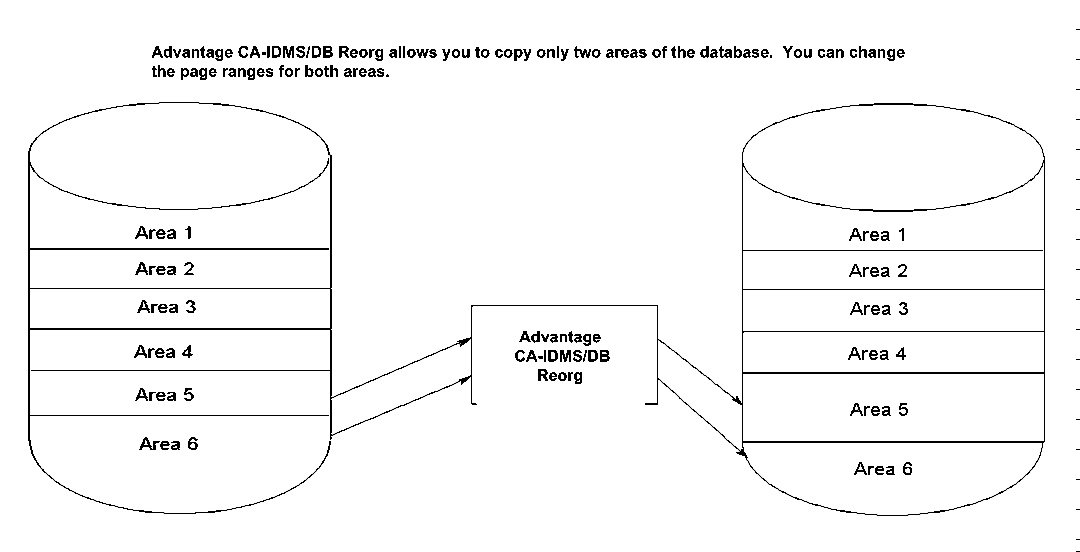
Many reorganization capabilities depend on how you have defined the new subschema and DMCL. During reorganization, CA IDMS/DB Reorg compares the area, set, index, and record definitions in the new subschema with those in the old subschema. After comparing the old subschema with the new subschema, CA IDMS/DB Reorg has the capabilities to:
- Eliminate logically deleted records. When CA IDMS logically deletes records, the data is removed from a record, but the prefix remains intact. CA IDMS/DB Reorg automatically deletes logically deleted records (LDELs) in areas that are being copied. This means that you do not have to use another utility to eliminate logically deleted records prior to using CA IDMS/DB Reorg.
- Expand/reduce the number of index table entries. CA IDMS/DB Reorg allows the SR8 record type to change its record size (a change in record size is otherwise considered to be a restructure feature and is not allowed). Changing the size of an SR8 record by changing the INDEX BLOCK CONTAINS value in the subschema gives you control over the number of levels required to build an index. This change to the subschema does not require recompilation of any programs.
- Move a record type to another area. For performance, backup, or security purposes, you can direct CA IDMS/DB Reorg to move a record type to a different area. This is done by changing the record's WITHIN clause in the new subschema's schema and reorganizing both the record's old area and new area.
- Change a record's location mode. By analyzing statistics from the CA IDMS Journal Analyzer and CA IDMS/DB Analyzer, you may determine that VIA records would be in better locations if they were clustered around a different owner. CA IDMS/DB Reorg also allows you to change a record's current location mode to or from DIRECT, CALC, or VIA. However, because CA IDMS/DB Reorg does not compress or decompress records, the control length of variable or fixed compressed records must not change.
- Optimize VIA records. CA IDMS/DB Reorg reclusters VIA set occurrences so that VIA members are stored physically in set order. This reduces the number of I/Os required to walk the set.
Copyright © 2014 CA.
All rights reserved.
|
|