

IMBSEQ is the Assembler macro that replaces:
IMBSEQ generates tables containing information to support the sequential processing requested by GE$T, PU$T ST$DA, and ST$KY macros in bridged programs. You can place this macro anywhere in the application program, however, it must appear only once.
►►─── IMBSEQ (file-name,set-name,end-of-data-address) ────────────────────────►◄
A required constant that identifies the macro; you can code it anywhere after column 1.
Specifies the seven-character name of the DBOMP file. One file-name entry must exist for every master file referenced in the bridged program.
Specifies the name of the set as it appears in the subschema.
Specifies the end-of-data address for the accompanying file-name. One end-of-data-address entry must exist for every file-name.
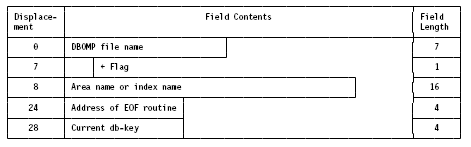
IMBSEQ builds one sequential table for each file named in the macro. Each table contains the following values:
Sequential File Table Layout
The following figure illustrates the layout of the sequential file table.
The IMBSEQ macro requires entries for only those files that are processed sequentially by the DBOMP program. In IMBSTAB, you must describe all files entered in this macro and referenced in the program.
The macros that generate the PL/I and COBOL interfaces include the logic necessary to generate the tables required for sequential processing. The layout for these tables is the same as for those generated by the IMBSEQ macro.
For more information on the PL/I interface, see PL/I Considerations. For more information on the COBOL interface, see COBOL Considerations.
|
Copyright © 2013 CA.
All rights reserved.
|
|