

Use the CA IDMS Server type 4 JDBC driver when executing Java programs that use JDBC to access CA IDMS databases.
Business Value:
The CA IDMS Server JDBC driver is tightly integrated with CA IDMS SQL processing for optimized SQL access to both non-SQL and SQL-defined CA IDMS databases.
The type 4 JDBC driver provides for optimal performance and response time for web and client/server Java applications accessing CA IDMS. With the type 4 JDBC driver, the Java client program is able to communicate directly with the CA IDMS region through native TCP/IP. This eliminates the need for any middleware address space, such as CCI, and frees mainframe processing for other workloads.
Additional Considerations:
CA IDMS Server supports the four types of JDBC drivers as defined by Sun.
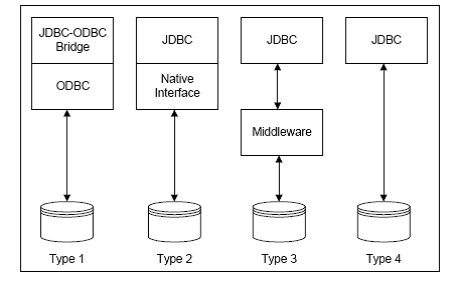
The four types of JDBC drivers differ in the way they communicate with the database and whether they use native code on the client platform:
Uses an ODBC driver to communicate with the database. ODBC drivers are always implemented in native code. The JDBC-ODBC Bridge is a basic Type 1 driver that is rarely used now that database specific drivers are available.
Invokes the native client interface to communicate with the database.
Uses a generic network protocol to communicate with a middleware server that invokes the native client interface to communicate with the database. It uses no native code on the client platform.
Communicates directly with the database using its proprietary protocol. It uses no native code on the client platform. This provides the most flexible and efficient way of communicating with the back-end database.
To enable the type 4 JDBC driver, define a TCP/IP line and a listener PTERM on the mainframe and specify the host name and port on the client. A Java application can establish a connection through the type 4 JDBC driver using either an IdmsDataSource object or the static DriverManager class.
The type 4 JDBC driver supports a large number of concurrent connections and is essentially limited only by the resources allocated to your CA IDMS system. In particular, you may need to increase the size of storage pools to support high volume applications that create many concurrent connections.
CA IDMS uses a minimum of 250 KB of storage for each dynamic SQL session, whether started by the type 4 driver, the type 2 or ODBC drivers, OCF, or IDMSBCF.
The following illustration shows the layers of processing involved for each type of JDBC driver in the client/server architecture.
More Information:
For more information about the type 4 JDBC driver and detailed information on how to specify client settings, see the CA IDMS Server User Guide.
For detailed information about defining the TCP/IP line and listener, see the CA IDMS System Generation Guide.
|
Copyright © 2013 CA.
All rights reserved.
|
|