

Operative and Nonoperative Status
A dialog can have an operative or a nonoperative status within the application thread. A dialog becomes operative when it receives control and begins executing; at a given level, only one dialog can be operative at a time. When control passes to a dialog at another level, the issuing dialog can remain operative or can become nonoperative, depending upon the level of the next dialog. For example, when control is passed with the LINK command, the issuing dialog remains operative; when control is passed with the TRANSFER command, the issuing dialog becomes nonoperative.
As long as a dialog is operative, all data that it has acquired is retained. When a dialog becomes nonoperative, its data is released. See "Database currencies" later in this chapter for a summary of the way in which a dialog's status is affected by the successful execution of a control command.
Application Thread
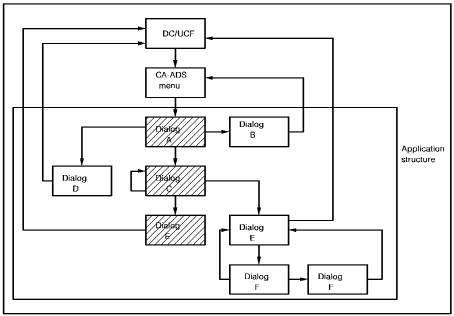
Within the application structure, only one dialog executes at a time. The sequence of dialog execution within an application structure is called the application thread. The response of the terminal operator determines the dialogs that constitute a given application thread. The following diagram shows an application structure and one application thread.
One dialog can exist in several places within the application structure and be part of the same or different application threads. A dialog can execute more than once within the application thread whether or not it remains operative.
In the diagram below, the shaded boxes represent an application thread that includes dialog A, dialog C, and dialog D.
|
Copyright © 2013 CA.
All rights reserved.
|
|