

An External Action Block (EAB) defines the interface between the procedure step or action block that invokes it and the logic created outside of CA Gen (that is, handwritten subroutines). An EAB provides a structure that is used to match the views of a procedure step with the views (input and output arguments) of a handwritten subroutine. For a list of conditions that must be satisfied on the development platform prior to implementing EABs on your target system, see the chapter Prerequisite Implementation Tasks.
The relationship of building EABs to the other required and optional IT tasks is described in the following illustration:
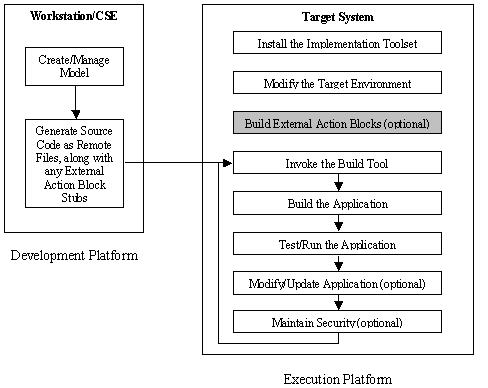
The single action statement EXTERNAL, which appears in the action block itself, distinguishes EABs from action blocks that are generated by the current model.
EABs are created when a code is generated. The CA Gen software cannot generate actual code for EABs, but the software creates a stub during code generation. This stub specifies the information that your external subroutine provides to the CA Gen application through the EAB and the information that your external subroutine expects to receive.
When an EAB is generated, the CA Gen software creates:
To make the action block usable, add either a call to an existing subroutine, or the logic necessary for the action block to perform its function.
For an application to properly execute on a target system, the EAB file is copied to the target system where the appropriate logic must be added to the generated action block stub before it is compiled and installed. A number of steps are required before the load module containing the EAB is built and implemented. These steps are outlined in the next section.
|
Copyright © 2015 CA Technologies.
All rights reserved.
|
|