

CA Gen Tuxedo support enables the use of Transaction Management in Tuxedo when an application is operating in a Server Procedure Step (PStep). With CA Gen, the Tuxedo Server runtime supports a Server PStep flowing to other Server Psteps. This support is accomplished through a PStep Use statement that establishes server-to-server flows. It is these server-to-server flows that operate and are controlled under the Transactional Management of Tuxedo.
A Tuxedo Server Manager PStep can either be the initial PStep in a transaction or a participant in the current transaction. If a current transaction does not exist when a PStep begins, the PStep creates a new (current) transaction. If a current transaction is in progress when the PStep begins, the PStep becomes a participant in the current transaction and so extends the transaction.
Invoking a Pstep is controlled through a model property. This property identifies if the PStep will participate in an existing distributed transaction and is defined using the Distributed Transaction Participant check box on the CA Gen Toolset or CSE PStep Properties dialog, shown in the following illustration.
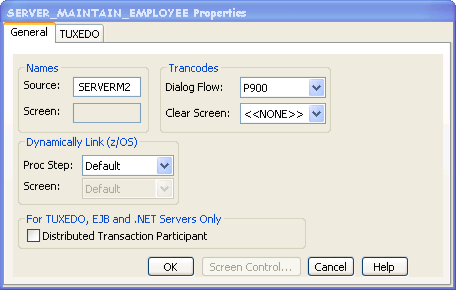
If this check box is not checked (the default setting), the PStep is invoked in a non-transaction mode. Flows to this server will always execute under the control of a new transaction.
If the check box is checked, the PStep is invoked in transaction mode (if one exists) and the PStep extends the current transaction. If a current transaction does not exist when the PStep is invoked, a new transaction is created.
|
Copyright © 2015 CA Technologies.
All rights reserved.
|
|