

Follow these steps:
 icon from the toolbar.
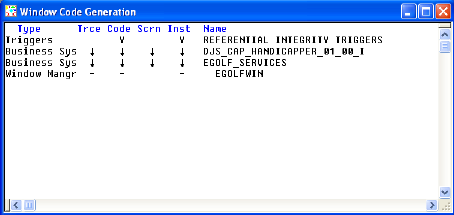
Notice in the Window Code Generation diagram the six columns:
The Type column describes the type of object you are referring to, while the Name column gives the name of that object. For example, REFERENTIAL INTEGRITY TRIGGERS is a Triggers type object. These will make a little more sense when we get into the actual application code generation. As for the other columns, Trce is an abbreviation for trace, Code means source code, Scrn is an abbreviation for screen, and Inst is an abbreviation for install.
If we want to generate code for a particular object, we click the dash (–) under the Code column for that object. Generating the code for some object just generates the source code, such as COBOL, C, or Java. If we actually want the source code compiled, linked with other compiled code, and in some cases bound to a DBMS, we would also select the dash under the Inst column. If we were generating a Blockmode application, it would likely have a green screen associated with it. To generate the screen, we would select the dash under the Scrn column. Finally, CA Gen provides the capability to trace through the executing code to assist with debugging. To enable this capability, additional code needs to be added to the generated source code. To add this additional code to the generated source code, you select the dash under the Trce column. Triggers have no screen and cannot be traced; therefore there are no dashes under those columns.
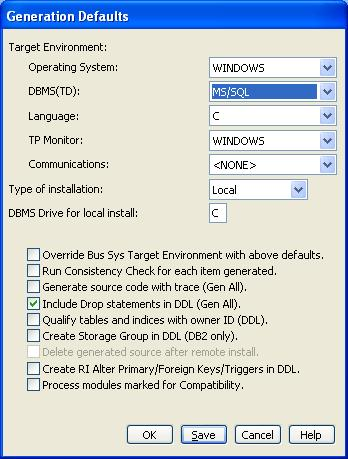
 icon from the toolbar to initiate the code generation and compilation. You will very briefly see the Generation Progress dialog again, which closes automatically if the Trigger generation is successful.
Note: If you left the Build Tool open after the successful database installation, you will still see the IEFDB line item as well. If you had closed the Build Tool, then you will now only see the Cascade line item.
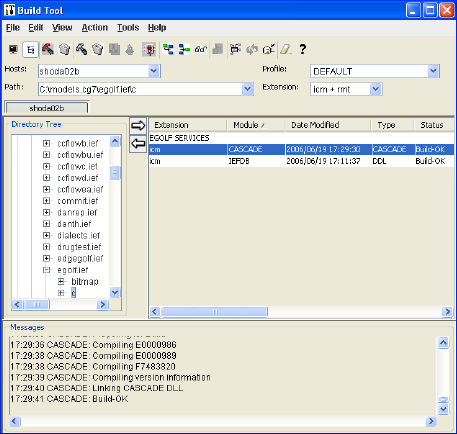
To review, what we have done so far is generate the Database and the Referential Integrity Triggers. Unless there is a change to the logical or physical database design, then these two tasks would normally not be done again.
|
Copyright © 2013 CA.
All rights reserved.
|
|