

Consider the three-step procedure in the following illustration:
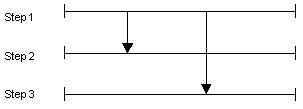
Under some conditions, Step 1 sets an exit state to transfer to Step 2. Under other conditions, Step 1 sets an exit state to transfer to Step 3. Step 2 does not transfer to Step 3.
When Step 1 sets an exit state that causes a transfer to Step 2, the Batch Manager for Step 1 sets a return code of 120 and terminates. The JCL EXEC statement for Step 2 has a conditional execution parameter of COND=(120,LT). Since 120 is not less than condition codes set, Step 2 begins execution. Since Step 2 does not transfer to another step, its Batch Manager sets a return code of 1000 when it completes. The JCL EXEC statement for Step 3 has a conditional execution parameter of COND=(130,LT). Since 130 is not less than condition codes set, the job terminates without transferring to Step 3.
When Step 1 sets an exit state that causes a transfer to Step 3, the Batch Manager for Step 1 sets a return code of 130 and terminates. The JCL EXEC statement for Step 2 has a conditional execution parameter of COND=(120,LT). Since 120 is less than any condition code set, Step 2 is bypassed. The JCL EXEC statement for Step 3 has a conditional execution parameter of COND=(130,LT). Since 130 is not less than any condition code set, Step 3 begins execution. Since Step 3 does not transfer to another step, its Batch Manager sets a return code of 1000 when it completes.
|
Copyright © 2015 CA Technologies.
All rights reserved.
|
|