

The following diagram shows an example of a Windows GUI Client communicating to a CA Gen WebSphere MQ Server. This diagram depicts the relationship of the application components and WebSphere MQ when processing a cooperative flow.
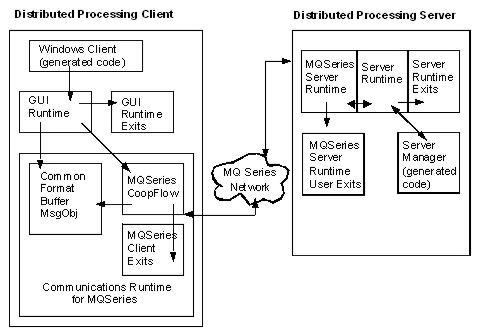
CA Gen DPC applications initiate cooperative flows to DPS applications. When a window manager is generated, the set of server environment parameters associated with the server manager that contains the target Pstep determines the transport type used by the DPC, for a given flow. That is, the communication type associated with the server manager must be set to WebSphere MQ before the window manager is generated. The subset of server environment parameters describing WebSphere MQ values are also important, as they control the interface between the DPC and WebSphere MQ so that the DPC can communicate with the Psteps located within the given server manager.
The set of server environment parameters describing WebSphere MQ attributes define the following:
Distributed Processing Client (DPC) applications can dynamically load one of two WebSphere MQ libraries to provide access to their local queue managers. The value of the client type parameter allows the DPC to communicate directly with a WebSphere MQ server, or to make use of the WebSphere MQ client software. The default causes the supporting runtime to dynamically load a CA Gen runtime library that uses the WebSphere MQ client software.
Defines the name of the local queue manager. The default queue manager is defined within WebSphere MQ configuration.
Defines the queue name associated with the server manager containing the target Pstep. The default is to use the name of the associated server manager.
Provides the name of the queue that defines the reply-to queue. By default the reply-to queue parameter defines a dynamic queue, and has the value:
SYSTEM.DEFAULT.MODEL.QUEUE
If the specified reply queue name provides the name of a model queue, WebSphere MQ creates the reply-to queue as a dynamic reply-to queue. The dynamic reply-to queue takes its attributes from a specified model queue. The name of the resulting dynamic queue defaults to:
username.taskid.threadid.*
You can override the default value using a CA Gen provided user exit. The user exit is specific to the language in which the MQ client is implemented.
Note: For more information about these user exits, see the User Exit Reference Guide.
Optionally, the reply-to queue parameter can specify the name of a local queue. MQSeries configures the attributes of the local queue, which can be defined to its queue manager as being shared or non-shared.
|
Copyright © 2013 CA.
All rights reserved.
|
|