

For synchronous cooperative flows, the client application blocks execution until the outstanding response is received. This blocking behavior prevents the requesting application from engaging in any processing that is concurrent to the execution of an outstanding cooperative flow request.
Using synchronous cooperative flows causes a DPC to serialize its processing when it has to flow to other target procedures. Processing within the DPC cannot continue until control is returned to the DPC from a previously executed cooperative flow.
Within a CA Gen model a synchronous cooperative flow is generated when using the following types:
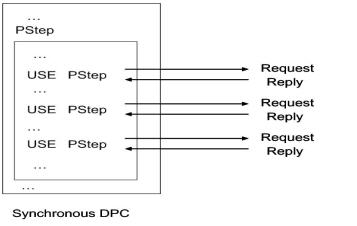
The following illustration depicts a DPC that contains three synchronous cooperative flows. The processing within the DPC suspends its execution until the target Procedure Step returns control to the DPC. The synchronous cooperative flow behaves as a Remote Procedure Call (RPC).
A user-written client application that uses a proxy can perform a synchronous cooperative flow to a DPS by using the execute mechanism that is exposed in the proxy that is associated with the target PStep.
|
Copyright © 2014 CA.
All rights reserved.
|
|