

For large-scale adoptions, consider adopting the objects in multiple sessions. Some selectable objects must be adopted during the same session (or previous session); others have no dependencies.
The general rule is that subordinate objects cannot be adopted unless their parents share common ancestry. If you select parent objects for adoption in the same session as the dependent objects, the parent objects are processed first. Therefore, adoption in the same session is sufficient to meet the rule.
Use the following guidelines to group the model objects into multiple aggregate sets and plan the sequence of adoption. If you select aggregate object types in the following sequence, and select all occurrences of each type, you will avoid encountering problems due to a missing object on which a selected object depends.
The following is the recommended Adoption Sequence:
The following three graphics assume all occurrences of all aggregate object types numbered 1-7 are in an aggregate set adopted during session 1, 8-13 in session 2, and 14-21 in session 3.
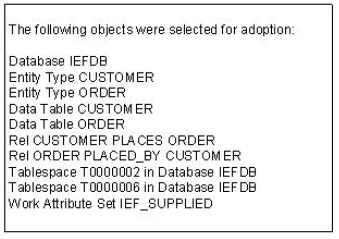
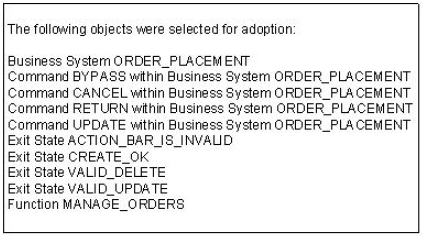
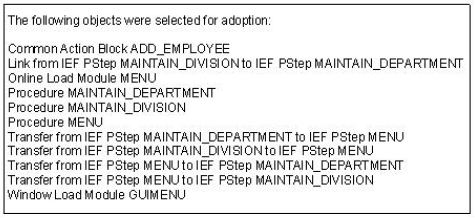
|
Copyright © 2013 CA.
All rights reserved.
|
|