

Setting the specifications for the target environment and construction paths is one of the activities you must complete before generating the IPs. The Environment option is used to specify the parameters for the environment in which a CA Gen-generated application executes (the production environment). The Construction Paths provide locations for the files created during generation.
The following illustration depicts an overview of environment and path parameter usage:
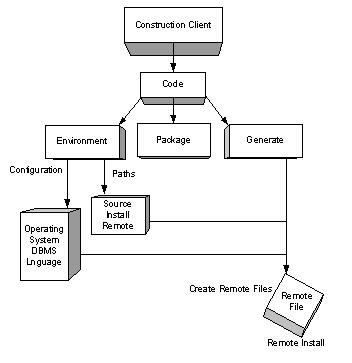
The target configuration and paths for load modules and batch jobs are specified at the business system level for online, batch, and windowed applications. For client/server (Cooperative) applications, you must set environment parameters for both window manager (client) and server manager (server) for each load module.
|
Application Component |
Environment |
Paths |
|---|---|---|
|
Load Module |
model (encyclopedia) |
model (encyclopedia) |
|
DDL |
local (client) |
model (encyclopedia) |
|
RI triggers |
local (client) |
model (encyclopedia) |
Note: Regardless of the platform, the term Load Module is used in the Packaging process as a generic way to refer to the set application code that is contained in a fully resolved executable application. Starting with AllFusion Gen 7, applications when installed on z/OS are built as fully resolved executables that reside in DLLs, except for those application components marked for Compatibility. Components marked for Compatibility are built as z/OS non-DLL load modules. Before AllFusion Gen 7, z/OS executables reside in z/OS load modules.
Check the environment and paths for the RI trigger modules before each trigger generation, to be sure that they are correct. RI trigger environments and DDL environments are shared. If you set override for either one, you are also changing the environment for the other.
The following sections describe the rules for setting environment parameters and construction paths.
|
Copyright © 2013 CA.
All rights reserved.
|
|