

It is important to remember that the user's view of a business process may differ significantly from the formal organization structure and current systems that tend to support that structure. To satisfy his customer, the user may need to cross many organizational boundaries, involve several organizational units and make use of multiple functional systems.
This difference in viewpoints is illustrated in the following illustration.
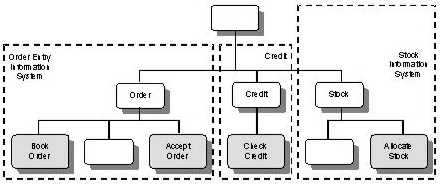
This illustration shows how the business is organized into departments that traditionally have been supported by separate information systems:
These systems often will have been identified by a top‑down analysis of the business processes such as information engineering. While this approach is still valid today, it does not yield the optimum solution on its own.
To completely satisfy the customer request, “Please supply me some goods,” a variety of actions must be taken by each of these departments. While the separate information systems support the work of the individual department, none of them focus on the end-to-end process of responding as effectively and as quickly as possible to the customer. Only one department, Order Processing, may have contact with the customer. Often this contact is indirect through a sales person or the mail. The apparent “customer” of the Accounting Department might be perceived as the internal Order Processing Department.
One of the key business benefits of client/server computing is better support for the external customer by focusing on the overall, end-to-end process. We all know that as customers ourselves, we prefer to deal with a business that is focused on us, and we often show our appreciation by submitting repeat orders and by recommendation. Where opportunities exist for a business to implement improved customer-oriented support, significant benefits can accrue.
How does this objective of improved customer-oriented support translate into the analysis and the eventual information development? The answer is through business event analysis.
For example, using business event analysis, we can determine that the event Order Arrival leads to a response of Sending an Order Acknowledgment. The information processes required to handle the Order Arrival are found by process decomposition and involve the three business areas: Order, Credit and Stock. Business event analysis focuses attention on the flow of control from start to finish “Order Arrival.” Any interruption in that flow can lead to the delay or loss of a response to the customer.
This example is illustrated in the following illustration.
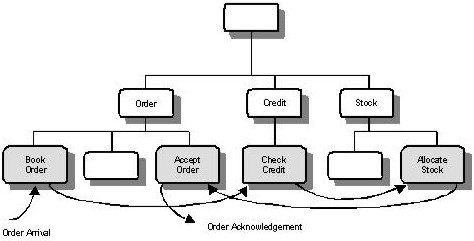
Event analysis identifies the complexity of the relationships between the various departments, the dependencies of the existing business processes.
Note: If this event were the subject of a Business Re-engineering study, the question might be asked whether the correct response to an Order Arrival is Order Delivery rather than Sending an Order Acknowledgment.
The analysis identifies that although the individual processes Order, Credit and Stock are supported by separate information systems, there is no system to ensure timely completion of the end-to-end process. Each information system (even if linked electronically) hands off to the next system.
An overview of the services currently provided in this example is shown in the following illustration.
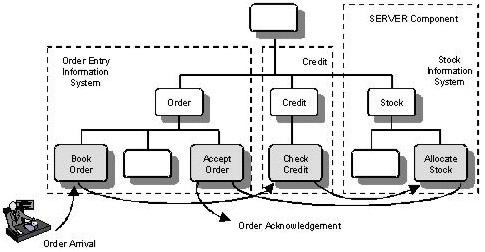
If we were merely setting out to rewrite our systems for client/server, then these existing information systems would be redesigned as components located on one or more servers.
The previous illustration shows which parts of the business event handling lack support. Any breakdowns in communication in these areas would mean delays in Sending an Order Acknowledgment.
Business users have to track new Orders and chase delays in response by various departments (Is there an answer yet from the Stock department to the Order from ABC company for the supply of 10,000 left boots?). Traditional computing technologies did not handle inter-departmental interactions easily. Typically, coordination was left to manual mail procedures to ensure that action followed action correctly and without delay.
What is needed on top of the traditional information systems (now located as components on the server) is a layer of computerized support with work queues, inter-departmental messages, time-out alarms for late response, and so on.
This is illustrated in the following illustration.
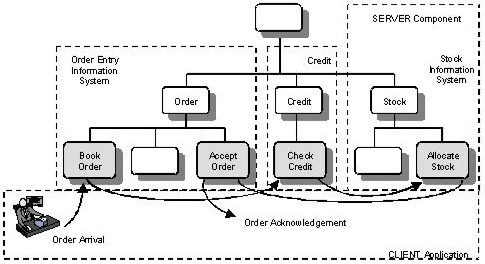
This illustration shows the business user (and perhaps most importantly, the business customer) supported by a client‑based application. The user and this client application are the main focus of attention.
CA Gen enables the client application with its links to server components.
The prime purpose of the client application is user task support. The application's effectiveness can be validated by its ability to handle business events.
The client application makes use of one or more server components, each of which is a conventional information system (excluding any presentation logic). These server components should provide a complete information handling and integrity service incorporating both the business data and the business rules.
If these components are to be reusable, they should also incorporate data validation even though any well-designed client applications would already apply validation.
This approach ensures that the enterprise data is protected and processed according to agreed-upon business rules no matter how many different client applications (of whatever quality) make use and reuse of these components.
Obviously, there are many ways for a business to organize, including the following ways:
|
Copyright © 2013 CA.
All rights reserved.
|
|