

This relationship is used for alternative implementations of the same elementary process, for instance, where different users have differing access and update authorities when performing the same process.
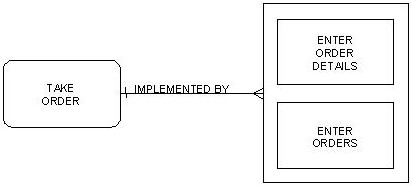
For example, consider a single elementary process named Take Order. Two groups of users execute this elementary process. One group, the expert group, takes orders extremely often. To satisfy their needs, a single procedure must be able to take many orders. The other group, a casual group of users, takes orders occasionally and, therefore, needs more reference material on the screen. To satisfy their needs, a single procedure must take only one order. In both cases, the elementary process Take Order is being implemented. Only the details of how Take Order is implemented vary.
In this instance, one elementary process is implemented in multiple procedures, as shown in the following illustration.
|
Copyright © 2013 CA.
All rights reserved.
|
|