

A Java client program populates the objects with the following required parameters:
Specifies the data source repository (CA Endevor SCM) that the client wants to access. This value must match the name of a valid configuration file accessible by Web Services. For more information, see How to Create a Configuration File and How Access to the Data Source Works.
Specifies the user ID for access to the CA Endevor SCM API.
Specifies the password for access to the CA Endevor SCM API.
Specifies the SCL statement entered by the user of the client application.
For any getObject service request, a Comma Separated Value utility List statement is required. For more information about List statements, see "Using the Comma Separated Value (CSV) Utility" in the Utility Guide.
(Optional.) Specifies parameters and values to override wsParameters specified in the configuration file. These parameters are Lang, TimeZone, CodePage, LSF.Encoding, Encoding, CharacterSet, ContentType, Trace, and Tracer. For more information, see Configuration File Parameters.
Specifies the type of SCL request. All the SCL specified in a request must be for the same type. Valid values follow:
A – Specifies environment administration actions.
C – Specifies Comma Separated Value (CSV) utility actions. Required for any getObject service request.
E – Specifies element actions.
P – Specifies package actions.
S – Specifies package ship actions.
X – Specifies batch ACM Query utility actions.
L – Specifies Add, Update, or Retrieve requests that required local file system (LSF) support. The SCL statements for these actions require the To | From Attachment clause to specify the location on the local client where the data will be transferred to or from.
Note: Use Category E for Add, Update, or Retrieve requests that are not LFS requests (with the Attachment clause) and that use either To | From DSName or To | From Path HFSFile.
Specifies the timezone where the client application is located. Web Services uses this value to determine the correct time, on the client side, for use in messages.
Specifies the data set on the client side that contains the data being exchanged.
Note: For the base64Binary type, the DATA are coded with the 64Binary translation and manipulated by a data handler or without any translation and appended as a MTOM attachment. The client code is expected to fill the DD property using a data handler (in the case of the 64binary translation) or as MTOM attachment to take advantage of the streaming.
Specifies the attachment name that references what is being exchanged.
Specifies the data type being exchanged. Specifies how the data transported by the Attachment objects of the client call are coded. This value informs Web Services how to format the data part of the attachment. ContentType is a standard of the Multipurpose Internet Mail Extensions (MIME) message protocol used by HTTP for complex messages, including messages with file attachments.
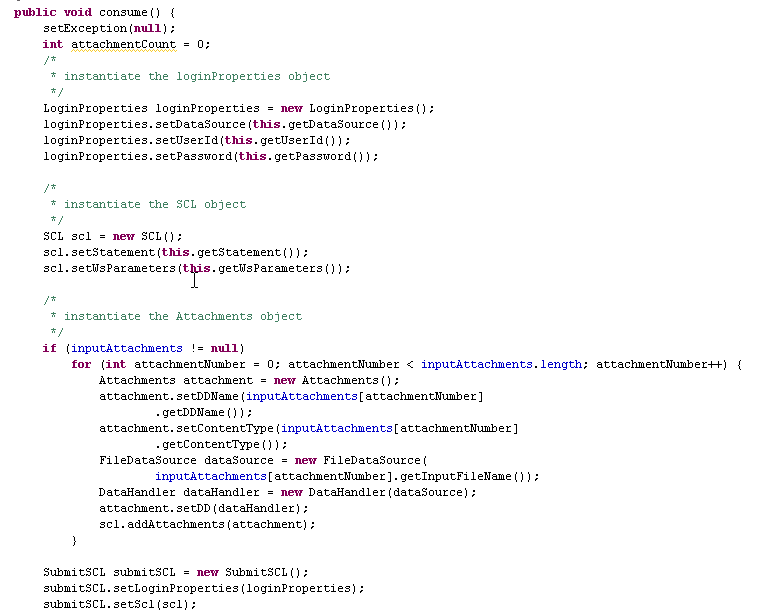
Example: Client Program in Java for the SubmitSCL Service
A Java client program invokes a stub (generated from the WSDL) and runtime (AXIS2/Java). The following sample program for the submitSCL service instantiates the loginProperties object, the SCL object, and the Attachments object. The client program populates the objects with the values required for a specific client request.
The request includes the login properties for access to a specified CA Endevor SCM repository. The request also includes the SCL statement and optional parameters, as well as a SOAP Attachment, used to submit an SCL statement and data to Web Services.
|
Copyright © 2013 CA Technologies.
All rights reserved.
|
|