

|
|
|
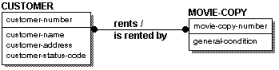
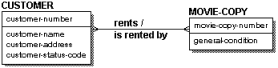
A many-to-many relationship, also called a non-specific relationship, represents a situation where an instance in one entity relates to one or more instances in a second entity and an instance in the second entity also relates to one or more instances in the first entity. In the video store example, a many-to-many relationship occurs between a CUSTOMER and a MOVIE COPY. From a conceptual point of view, this many-to-many relationship indicates that:
You typically use many-to-many relationships in a preliminary stage of diagram development, such as in an ERD, and are represented in IDEF1X as a solid line with dots on both ends.
Since a many-to-many relationship can hide other business rules or constraints, they should be fully explored at a later point in the modeling process. For example, sometimes a many-to-many relationship identified in early modeling stages is mislabeled and is actually two one-to-many relationships between related entities. Or, the business must keep additional facts about the many-to-many relationship, such as dates or comments, and the result is that the many-to-many relationship must be replaced by an additional entity to keep these facts. You need to fully discuss all many-to-many relationships during later modeling stages to ensure that the relationship is correctly modeled.
| Copyright © 2011 CA. All rights reserved. | Tell Technical Publications how we can improve this information |