

|
|
|
If you are familiar with a relational database structure, you know that the most fundamental component of a relational database is the table. Tables are used to organize and store information. A table is organized in columns and rows of data. Each row contains a set of facts called an instance of the table.
In a relational database, all data values must also be atomic, which means that each cell in the table can contain only a single fact. There is also a relationship between the tables in the database. Each relationship is represented in an RDBMS by sharing one or more columns in two tables.
Like the tables and columns that make up a physical model of a relational database, an ERD (and all other logical data models) includes equivalent components that let you model the data structures of the business, rather than the database management system. The logical equivalent to a table is an entity, and the logical equivalent to a column is an attribute.
In an ERD, an entity is represented by a box that contains the name of the entity. Entity names are always singular: CUSTOMER not CUSTOMERS, MOVIE not MOVIES, COUNTRY not COUNTRIES. By always using singular nouns, you gain the benefit of a consistent naming standard and facilitate reading the diagram as a set of declarative statements about entity instances.
The figure that follows is one created by a hypothetical video store that needs to track its customers, movies that can be rented or purchased, and rental copies of movies that are in stock in the store.
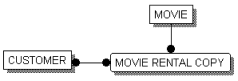
In an ERD, a relationship is represented by a line drawn between the entities in the model. A relationship between two entities also implies that facts in one entity refer to, or are associated with, facts in another entity. In the previous example, the video store needs to track information about CUSTOMERs and MOVIE RENTAL COPYs. The information in these two entities is related, and this relationship can be expressed in a statement: A CUSTOMER rents one or more MOVIE RENTAL COPYs.
| Copyright © 2011 CA. All rights reserved. | Tell Technical Publications how we can improve this information |