

|
|
|
An entity is any person, place, thing, event, or concept about which information is kept. More precisely, an entity is a set or collection of like individual objects called instances. An instance (row) is a single occurrence of a given entity. Each instance must have an identity distinct from all other instances.
In the previous figure, the CUSTOMER entity represents the set of all of the possible customers of a business. Each instance of the CUSTOMER entity is a customer. You can list information for an entity in a sample instance table, as shown in the following table:
CUSTOMER
|
customer-id |
customer-name |
customer-address |
|---|---|---|
|
10001 |
Ed Green |
Princeton, NJ |
|
10011 |
Margaret Henley |
New Brunswick, NJ |
|
10012 |
Tomas Perez |
Berkeley, CA |
|
17886 |
Jonathon Walters |
New York, NY |
|
10034 |
Greg Smith |
Princeton, NJ |
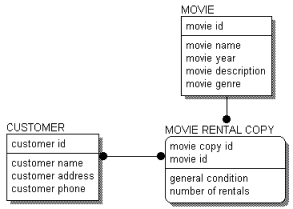
Each instance represents a set of facts about the related entity. In the previous table, each instance of the CUSTOMER entity includes information about the “customer-id,” “customer-name,” and “customer-address.” In a logical model, these properties are called the attributes of an entity. Each attribute captures a single piece of information about the entity.
You can include attributes in an ERD to describe the entities in the model more fully, as shown in the following figure:
| Copyright © 2011 CA. All rights reserved. | Tell Technical Publications how we can improve this information |