

The CA Disk volume-level backup function is invoked through DSCL. The volume-level backup function will create one backup tape (or a set of backup tapes) for each volume. Each tape or set of tapes will contain all of the data, starting at cylinder 0, track 0, and continuing through all used cylinders.
Because this is a full-volume backup function, change-bit actions are not observed, and DSNINDEX records are not written for the data sets on the volume.
CA Disk will request a new backup tape automatically if the backup processing switches to a new DASD volume. That is, if the volume-level backup includes two or more DASD volumes, the contents of the volumes are not mixed on the backup tapes.
The volume-level backup will look like one large data set to CA Disk. It will have one DSNINDEX record with an internally generated data set name of
DMSOS.Vxxxxxx
where xxxxxx is the volume serial. The DSNINDEX record points to the ARCHVOLS records that identify the tape volumes used for the backup.
CA Disk generates data set names for the volume-level backup tapes in the same manner as it generates names for the data set-level backup tapes created by ARCHIVE/BACKUP; that is, sysparms ARC0NAME and ARCCNAME provide the base-level name.
The DSNINDEX records for volume-level backups are flagged to indicate an extent track image backup with an x'01' in the second LISTD flag. The ARCHVOLS records for volume-level backups are flagged with an x'10' in the second LISTV flag.
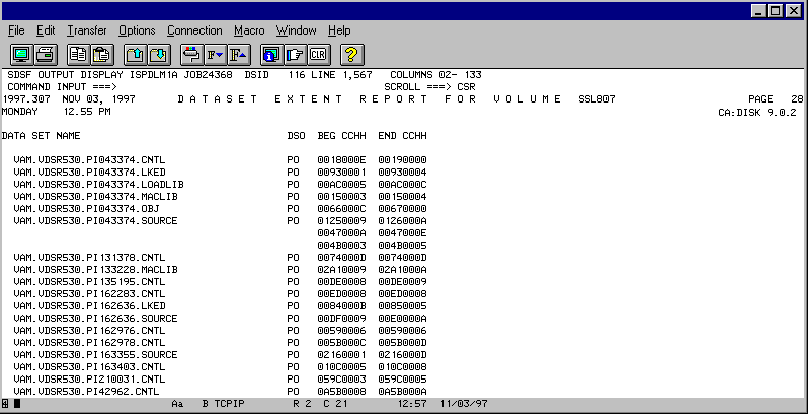
If you have instructed CA Disk to use data compression during backup processing (sysparm DCDATACP specified with a value of Y), volume‑level backup processing will either use the CA Disk-supplied techniques 0 or 2. The following illustration is a sample VBACKUP Command Report.
|
Copyright © 2015 CA Technologies.
All rights reserved.
|
|