

In theory, the names you assign to archive data sets are of no consequence to CA Disk. CA Disk keeps track of the archive data sets regardless of their names. However, other issues dictate that naming conventions be observed, including the IBM operating system and tape management concerns. CA Disk generates unique archive data set names, providing flexibility in managing the archives and allowing them to be cataloged. Unique data set names also eliminates contention during dynamic allocation that would occur if non-unique data sets were used.
CA Disk sysparm defaults generate unique archive data set names. The base names are taken from either sysparm ARC0NAME or ARCHIVE0 DD statement (for the primary copy) and sysparm ARCCNAME or ARCHIVEC DD statement (for the duplicate copy). If both copies are being produced, the base names should be different—such as DMS.ARCHPRIM and DMS.ARCHCOPY.
The following figure shows Generated 22 Character DSNAME on specifying up to 22 characters for the base name:
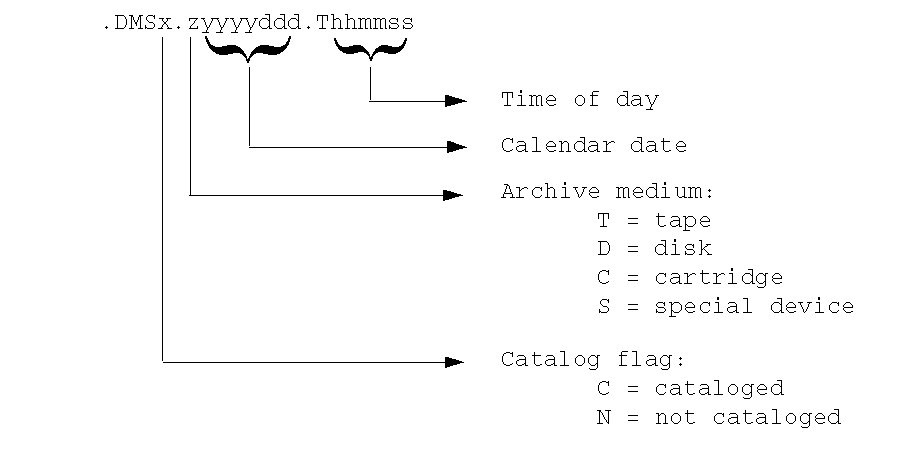
The previous calendar date is the current date in Julian format, and the time of day is in hours/minutes/seconds. Therefore, the archive data set name provides the date and time it was created, and is always unique.
For disk archive data sets, this generated name is always used and is always cataloged. For tape and cartridge archive data sets, the default is to use the generated name but not to catalog it. You can tell CA Disk to catalog the tape or cartridge archive data set name by specifying a value of C for sysparm ARCTNAME.
|
Copyright © 2015 CA Technologies.
All rights reserved.
|
|