

Before your source program is compiled, the SQL statements embedded in the host language program must be prepared (in a process called binding) by an CA Datacom/DB SQL Preprocessor for COBOL, PL/I, Assembler, or C (for the C language, the only supported compiler is IBM LE/370 C).
Note: Support for procedures and triggers requires a minimum of z/OS Version 2 Release 5 and compatible Language Environment for z/OS with the following IBM compiler products: z/OS C/C++ (only the C subset is supported), COBOL for z/OS, and PL/I for MVS.
Overview
The CA Datacom/DB SQL Preprocessor prepares the data sublanguage portions of a source program for execution by:
The following diagram approximates how this preparation phase is handled in the CA Datacom/DB environment.
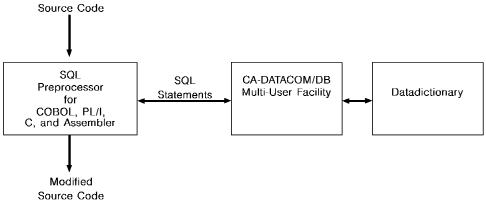
The Preprocessor:
The Preprocessor makes each embedded SQL statement in the host source into a comment and leaves it for documentation purposes. Each such executable statement is replaced with host language code to accomplish the required action.
If errors are detected in SQL statements or supporting data definitions, the Preprocessor issues appropriate error messages and takes appropriate action.
The CA Datacom/DB access plan is the control structure produced during the bind process. This preparation phase builds the plan for the application and binds each SQL statement to the appropriate table, view or synonym definition stored in CA Datacom Datadictionary. CA Datacom/DB uses the plan to process SQL statements encountered during application execution. Each program containing embedded SQL statements must have a plan before being executed.
If any dependencies (tables, views and synonyms) for a prepared statement change, the related statement is marked invalid and must be rebound before it can be executed again.
The SQL Manager automatically attempts a rebind when an invalid statement is executed. Rebinding can also be requested in advance. For more information, see Rebinding a Plan.
|
Copyright © 2014 CA.
All rights reserved.
|
|