

CA Datacom Server ODBC Driver is an ODBC 3.5 compliant driver. This driver implements the ODBC API and requires that your programs conform to the ODBC specification. It also requires that the Microsoft ODBC Driver Manager software is installed and operational. ODBC data sources must be defined to provide information about the CA Datacom Server. CAICCI-PC is not required. Through ODBC data source settings, you can choose to use CCI or native TCP/IP data transmission.
In a z/OS environment, CA Datacom Server supports native TCP/IP data transmission between workstations and host mainframes. CAICCI is required on the host mainframe. Through mainframe server startup parameters, you can choose to allow a CAICCI only transmission or CAICCI and TCP/IP transmission.
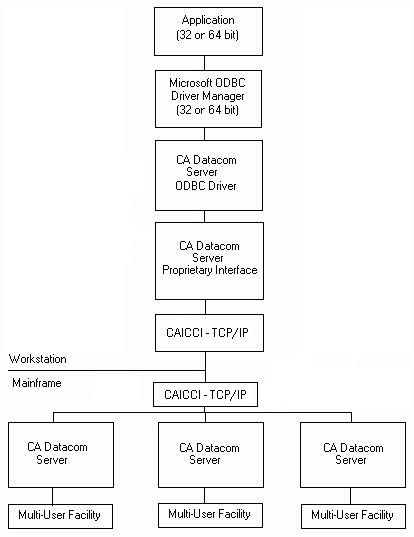
The following describes each of the ODBC architecture components:
SQL‑based workstation applications using the Microsoft ODBC interface running under Microsoft Windows can access data in a CA Datacom/DB database. An application issues a connect request to the Microsoft ODBC Driver Manager for a specific driver, such as CA Datacom Server.
The Microsoft ODBC Driver Manager resides on the workstation or web server. Any number of workstation applications can connect to the ODBC Driver Manager and the ODBC Driver Manager can connect to any number of drivers. The ODBC Driver Manager forwards an application's connect request to the appropriate driver, based on the identifiers in the connect call. Microsoft provides the Microsoft ODBC Driver Manager.
The CA Datacom Server driver is a 32/64‑bit thread-safe ODBC 3.5 compliant driver. Drivers, connected to ODBC, interpret calls from the Microsoft ODBC Driver Manager and make calls to CA Datacom/DB.
The cadcdb32.dll/cadcdb64.dll module provides the CA Datacom/DB proprietary interface, data mapping, data translation, and data communication services. It also supplies the CAICCI or native TCP/IP interface (z/OS only). A CCI request is sent through CAICCI to the CA Datacom Server on the mainframe. A TCP/IP request is sent through the data stream directly to the mainframe server.
CAICCI isolates CA Datacom Server from the communication protocol used between the workstation and mainframe. It is the communication protocol traditionally used with CA Datacom Server. When using this method of communication, CA Datacom Server can use only those protocols supported by CAICCI.
CAICCI is required on the host mainframe and is used for communication between Mainframe Server regions and the Server SVCOMPR utility. TCP/IP is the basic communication language or protocol of the Internet. CA Datacom Server supports native TCP/IP data transmission between workstations and z/OS host mainframes. It does not require CAICCI-PC. Through mainframe server startup parameters, you can choose to allow both CAICCI and TCP/IP or CAICCI only.
The CA Datacom Server Mainframe Server component executes in its own address space and connects to a specific Multi-User Facility (MUF). It processes connect requests from client applications, handles data transmission requests to and from client applications, and translates data between MUF and client applications.
In a z/OS environment, the Mainframe Server component provides support for native TCP/IP data transmission between workstations and host mainframes. Through startup parameters you can choose to allow native TCP/IP transmissions.
A MUF provides the ability to access any CA Datacom/DB database concurrently from multiple regions. Each server communicates with only one MUF, but a system can have multiple MUFs accessed by multiple servers or multiple servers accessing the same MUF.
|
Copyright © 2015 CA Technologies.
All rights reserved.
|
|