

The following diagram shows the deployment architecture for CA DLP Content Services. For the current release, CA DLP uses content database technology provided by Autonomy IDOL.
A single CA DLP content indexer handles data ingestion into a content database. The CA DLP content proxy server handles data retrieval from the content database when a content search runs. In both cases, the connection between CA DLP and the content database is handled by the IDOL connector framework.
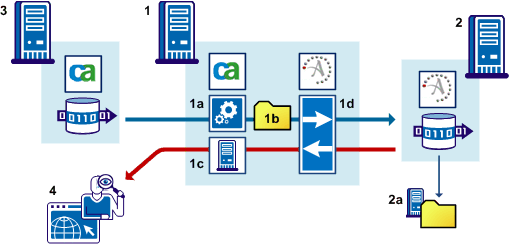
The Content Services server (1) hosts the CA DLP content indexer (1a), the transfer folder (1b), and the CA DLP content proxy server (1c). It also hosts the IDOL connector framework (1d).
The content database (2) normally runs on a dedicated server. Indexed event data is stored in a data folder (2a), which can be local or remote.
The content indexer extracts CA DLP emails and file events from the CMS database (3). These events are temporarily held in the transfer folder before being picked up by the connector framework. The connector framework submits these CA DLP events to the content database where their text content is analyzed and indexed.
When a CA DLP reviewer (4) runs a content search in the iConsole or Data Management console, the search query is channeled through the content proxy server and the connector framework to the content database. The search results are returned to CA DLP using the same mechanism.
|
Copyright © 2012 CA.
All rights reserved.
|
|