

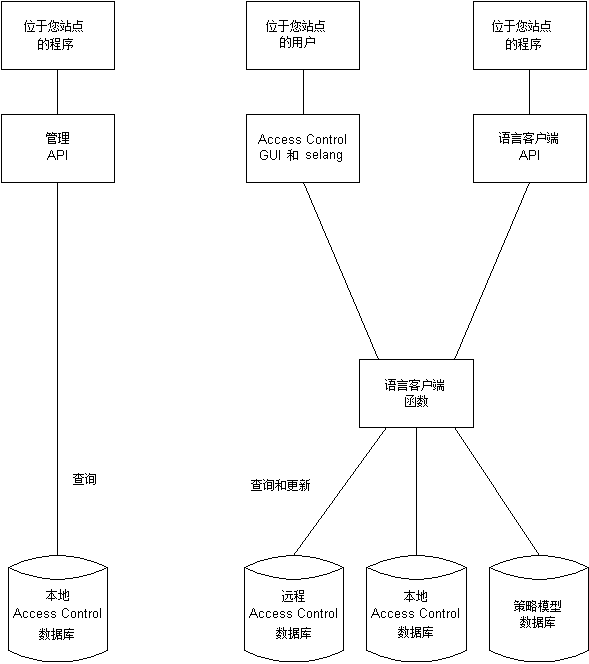
LCA 可以更新和查询 CA ControlMinder 本地数据库、远程数据库或 PMDB。 管理 API 只能查询本地工作站中的数据库。
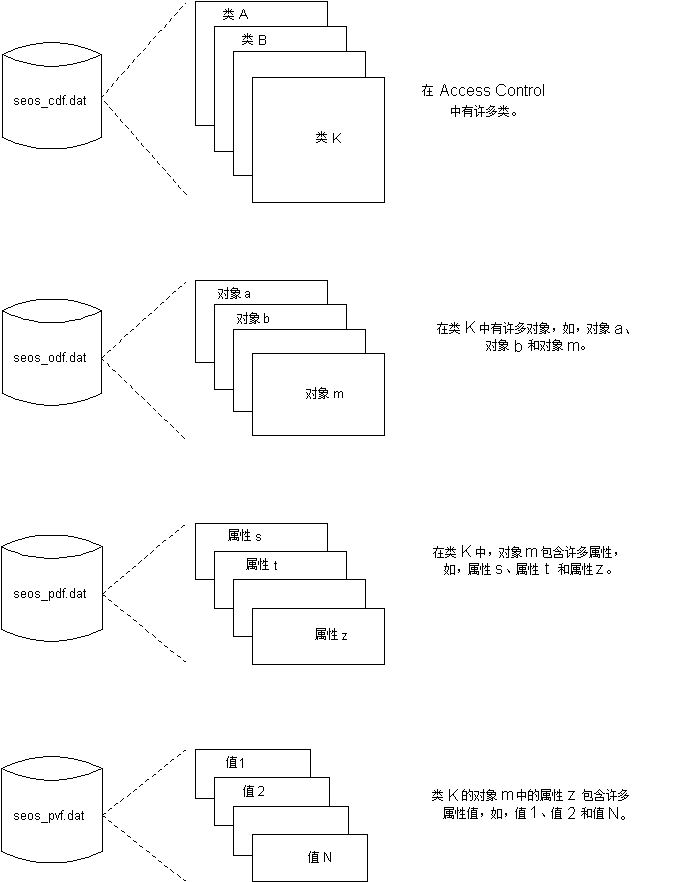
下图显示 CA ControlMinder 数据库的布局:
以下示例程序接收命令和(可选)属性名列表作为命令行参数。 程序假定命令为 selang 命令,属性名的显示格式与 dbmgr -d -r p ClassName 命令的显示格式相同(在旧版本 CA ControlMinder 中,与 rdbdump p 命令的显示格式相同)。
该程序调用 lca_ParseLine 函数来执行命令。 执行命令后,对结果进行分析。
如果命令成功,则调用处理查询数据的 API 例程,并显示查询结果。 (如果命令不是查询,则不显示查询信息。)如果提供的是属性列表,则仅显示这些属性的数据。 如果命令失败,则调用分析错误的 API 例程。
#include <stdio.h>
#include <string.h>
#include <memory.h>
#include <seostype.h>
#include <langapi.h>


static void scan_entities(void);
static void print_entity_info(LCA_QENT_H entity_handle);
static void scan_props(LCA_QENT_H entity_handle);
static void print_prop_info(LCA_QPROP_H prop_handle);
static void scan_values(LCA_QPROP_H prop_handle);
static void print_prop_value(LCA_QPROP_H prop_handle,void *prop_value);


static char  *Command = NULL;
static char **Properties = NULL;
static int    NProps = 0;

static void put_commands(int argc,char **argv);

int ShowUsage(void)
{
  fprintf( stderr, “Usage:\n
                    lca_examp Command [{List‑of‑property‑names}]\n”);
  return 1;
}

int main(int argc,char **argv)
{
  char  *output = NULL;
  int   rv;
  int   n_ents;
  char  buff [1025];
     /****************** 初始化 ***********************/
     /********************************************************/

    if ( argc < 2 )
        return ShowUsage();

    rv = lca_Init(“langapi”,&output);
    if ( rv )
    {
        printf( “Return value: 0x%08x\n”
              “Msg: '%s'\n”, rv, output );
        return 1;
    }

    put_commands(‑‑argc,++argv);

     /************** 命令执行 **********************/
     /********************************************************/

    rv = lca_ParseLine(Command, &output);
    /* 显示命令输出 */
    printf(“Command's output\n%s\n”, output);

    if (rv == 0)
    {

     /************ 成功 ‑ 获取结果 *******************/
     /********************************************************/


     /** 获取已返回的实体(对象)的数目 ***/
     /********************************************************/


        n_ents = lca_QEntsGetNum();
        printf(“number of entities returned: %d\n”,n_ents);


     /******* 获取实体(对象)的名称 *********/
     /********************************************************/

        scan_entities();
     }
     else
    {


     /******************* 命令失败 ******************/
     /********************************************************/

        LCA_ERR_H error_handle = NULL;


     /*********************************************************
     * 为了进一步分析错误,请查看所有错误
     * (通常只有一个错误,但是如果同时存在警告
     * 和错误,则列表中可能有多个错误)。
     *********************************************************/

        printf(“Numbers of errors: %d\n\n”,lca_ErrsGetNum());
        while ((error_handle = lca_ErrGetNext(error_handle))
                                                       != 0)
        {
            printf(“Severity: %d, Stage:%d\n”,
                                lca_ErrSeverity(error_handle),
                                lca_ErrStage   (error_handle));

     rv = lca_Err2Str (error_handle, buff, sizeof (buff)‑1);
            if ( rv )
                printf (“Error message: '%s'\n”, buff);
        }
      }

     /************** 终止使用 lca_ API **************/
     /********************************************************/

  lca_Terminate();
  return 0;
}

static void put_commands(int argc,char **argv)
{
  Command = argv[0];
  Properties = ++argv;
  NProps = ‑‑argc;
}

static void scan_entities(void)
{
  LCA_QENT_H entity_handle = NULL;

while ( (entity_handle = lca_QEntGetNext(entity_handle)) != 0 )
      print_entity_info(entity_handle);
}

/**************************************************************
输出一个实体的信息(包括名称、类名)及其属性信息。
如果实体是一个类,则“名称”为空,“类名”为完整名称。
如果实体是一个对象,则“名称”为完整名称,“类名”为空。
*************************************************************/


static void print_entity_info(LCA_QENT_H entity_handle)
{
  char    *name;

  if ( entity_handle == 0 )
    return;

  name = lca_QEntObjName(entity_handle);
  if ( name != 0 )
    printf(“\nName: %s\t”,name);
  name = lca_QEntClassName(entity_handle);
  if ( name != 0 )
    printf(“Class name: %s\n”,name);

  scan_props(entity_handle);

}

static void scan_props(LCA_QENT_H entity_handle)
{
  LCA_QPROP_H prop_handle = NULL;
  register int i;

    if ( NProps == 0 )
        while ( (prop_handle = lca_QPropGetNext(entity_handle,prop_handle)) != 0)
            print_prop_info(prop_handle);
    else
    for ( i = 0; i < NProps; i++ )
    {
        prop_handle = lca_QPropGetByName(entity_handle,Properties[i]);
        if ( prop_handle == 0 )
        {
            printf(“Property %s does not exist for this entity.\n”,
                           Properties[i]);
            continue;
        }
        print_prop_info(prop_handle);
     }
}

/*************************************************************
  此函数将获取一个属性句柄,以及:
  1. 获取其名称并输出该名称。
  2. 获取其值,将其转换为字符串,并输出该字符串。
*************************************************************/

static void print_prop_info(LCA_QPROP_H prop_handle)
{
  char *prop_name = NULL;
  char prop_type;
  unsigned short prop_size;
  unsigned int n_vals;

  if ( prop_handle == 0 )
    return;

  prop_name = lca_QPropName(prop_handle);
  if ( prop_name == 0 )
    printf(“Cannot get name of property. Handle: %d\n”,
                  prop_handle);

  printf(“\nPropname: %s.”,prop_name);

  prop_type = lca_QPropType(prop_handle);
  printf(“Property type: %d; “,prop_type);

  prop_size = lca_QPropSize(prop_handle);
  printf(“Property size: %d; “,prop_size);

  n_vals = lca_QPropValsNum(prop_handle);
  printf(“Number of values: %d.\n”,n_vals);


/* 遍历属性值,因为一个属性可能
存在多个值。
如果属性为类型列表(ACL、PACL、用户
列表、成员列表等),则会发生此情况。
*/

  scan_values(prop_handle);

}

static void scan_values(LCA_QPROP_H prop_handle)
{
  void *prop_value;
  int i;
  int n_vals;

    n_vals = lca_QPropValsNum(prop_handle);
    for ( i=0; i<n_vals; i++)
    {
      prop_value = lca_QPropValGetByIdx(prop_handle,i);
      print_prop_value(prop_handle,prop_value);
    }
}

static void print_prop_value(LCA_QPROP_H prop_handle,void
      *prop_value)
{
  char buff[1024];
  int n_vals;

  if ( prop_handle == 0 || prop_value ==0 )
    return;
  n_vals= lca_QPropVal2Str(prop_handle,prop_value,buff,sizeof(buff));
  if ( n_vals > 0 )
    printf(“Value: %s\n”,buff);
}
LCA 包括以下类别的函数:
langapi.h 文件包含每个 LCA 函数的基本说明。 langapi.h 文件位于以下目录:
以下函数控制 LCA 操作:
初始化 LCA。
使用可触发特定功能的特定通讯类型初始化 LCA。
终止 LCA。
执行 selang 命令。
执行 selang 命令并允许输入多字节格式字符串。
连接到一个或多个主机的列表。
以下函数控制 LCA 密码:
检查新密码是否符合密码规则。
以下函数对错误执行操作。 这些错误由执行操作函数造成:
返回最后执行的命令的错误记录数。
针对第 N 个错误记录返回 LCA_ERR_H 类型的错误句柄。
针对命令中的第一个错误返回 LCA_ERR_H 类型的错误句柄。
针对命令中的下一个错误返回 LCA_ERR_H 类型的错误句柄。
返回错误的主要错误代码。
返回错误的次要错误代码。
返回错误的主要错误代码的信息字符串。
返回错误的次要错误代码的信息字符串。
返回错误的重要级别。
返回错误发生时间的相关信息。
将错误记录转换为字符串格式并将其复制到缓冲区。
|
版权所有 © 2013 CA。
保留所有权利。
|
|