

The following diagram illustrates how CA SiteMinder® uses responses when processing a user’s request for resources.
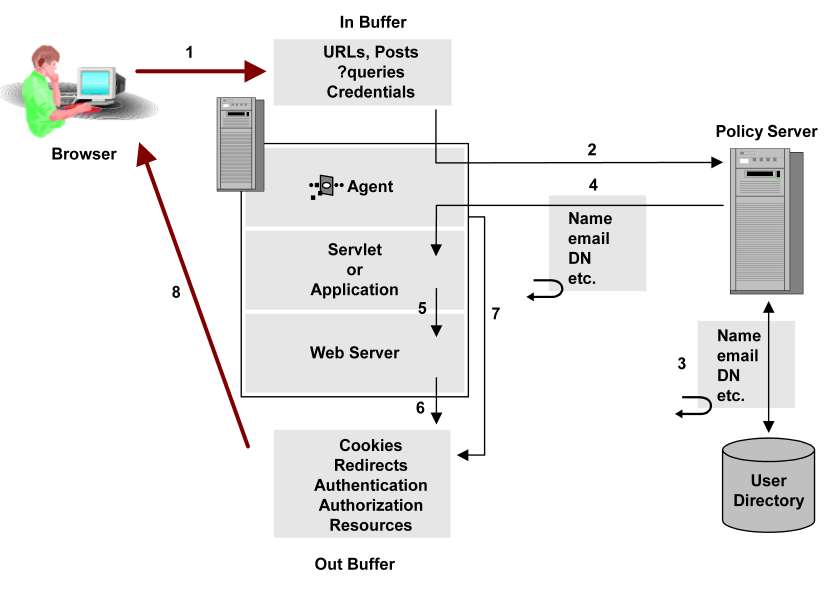
In the previous diagram, CA SiteMinder® processes responses using the following steps:
The In Buffer represents the Web Server buffer where the requested URL, Post data or query strings reside during Web Server processing.
Part of the authentication process binds the user to a record in a user directory.
The servlet or application executes its processes and passes its results to the Web Server.
The Web Agent may pass any of the following to the Out Buffer: CA SiteMinder® cookies, URLs for redirection, and successful /unsuccessful authentications or authorizations.
A response is a container for one or more response attributes. The response attributes are what a CA SiteMinder® Agent receives after the Policy Server processes a response. The available response attributes differ based on the type of response.
The following types of responses are available:
Note: You can create response types for custom Agents and response attributes using the CA SiteMinder® APIs, which are available separately with the Software Development Kit. More information exists in the API Reference Guide for C.
Web Agent responses are CA SiteMinder® responses that provide name/value pairs usable by a CA SiteMinder® Web Agent. These responses can contain attributes for HTTP header variables, cookie variables, and URLs for redirections.
Affiliate Agent responses are CA SiteMinder® responses that provide name/value pairs usable by a CA SiteMinder® Affiliate Agent. These responses can contain attributes for HTTP header variables or HTTP cookie variables.
RADIUS responses are CA SiteMinder® responses that provide values usable by a RADIUS Agent. These responses can contain response attributes for all supported RADIUS attributes.
Each CA SiteMinder® response contains one or more response attributes. These attributes differ based on the type of response. The following sections discuss the response attributes that are available for each type of response.
|
Copyright © 2014 CA.
All rights reserved.
|
|