

The Historical Performance Agent collects historical data and stores it in highly compressed files called performance cubes. These cubes are initially stored on the file system of the machine that the agent is monitoring, and are then automatically transferred to a designated Performance Distribution Server.
Cubes conform to a three-dimensional data model, as illustrated below.
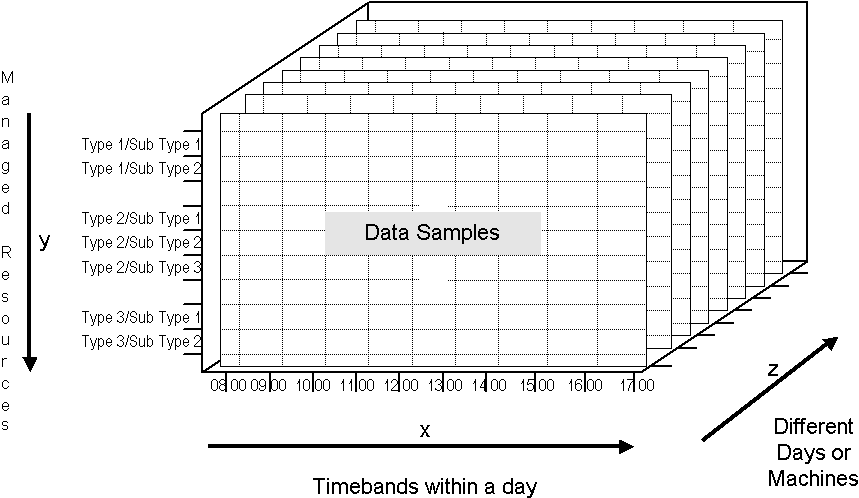
The three axes in this data model are as follows:
There are three types of performance cube:
These are a two‑dimensional matrix of the Y axis (resource metric) and X axis (up to 24‑hour timeband). You primarily use this cube to view how a resource is performing on a given day. Using this daily data lets you closely monitor resources on a real‑time basis.
These are similar to daily cubes except that they include the Z axis to track same‑machine performance over multiple days. For example, you might use a period cube to monitor how a machine has performed over the course of a month.
These are just like period cubes except that the Z axis represents different machines during a single day rather than the same machine during different days. For example, you might use an enterprise cube to monitor the performance of a related set of servers.
You can use the Performance Configuration application to set up your cube requirements.
|
Copyright © 2010 CA.
All rights reserved.
|
|