

Scheduling, as defined in the past, was the ability to schedule units of work (jobs) within a particular host (for example, z/OS or OS/390, Windows, UNIX/Linux, AS/400). This scheduling activity started with simple definitions:
Today many data centers are working with more complex production workloads that cover a wider variety of processing environments—including OS/390, UNIX/Linux, Windows, OpenVMS, and other platforms communicating with each other. Such an environment requires cross‑platform scheduling.
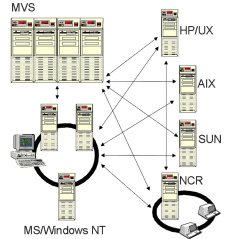
Cross‑platform scheduling provides integrated enterprise control. It defines and sets dependencies. It submits and tracks the status of units of work (jobs or events) not only on the traditional platforms (z/OS or OS/390, UNIX/Linux, Windows, AS/400) but on a variety of other platforms.
Actions result in the immediate and automatic notification of status changes to the unit of work (executing, completed successfully, error) and the ability to perform additional automatic actions. These status changes can trigger event‑dependent processing not only on the local platform but on other systems/resources throughout the environment to maximize enterprise processing efficiency.
CA provides distributed scheduling capabilities that enable integration of its z/OS or OS/390 (formerly MVS) products—Unicenter CA‑7, Unicenter CA‑Jobtrac, and Unicenter CA‑Scheduler—with the CA NSM JM Option.
|
Copyright © 2010 CA.
All rights reserved.
|
|