

The implementation model shows how the product is implemented and how the service is provided on a high level:
The following diagram illustrates how the DTS architecture implements both client/server and manager/agent methodologies. Together, these methodologies ensure that the implementation possibilities are flexible and scalable. In this illustration, the manager doubles as the server end of the client/server solution:
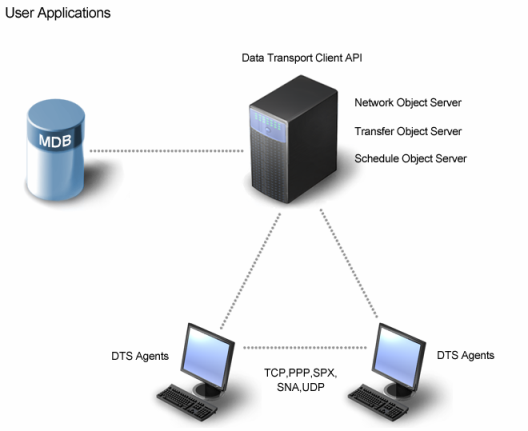
Applications that want to use DTS call the functions that are contained in the DTS client API, which instructs the DTS manager to carry out the requested task. The DTS manager (DTM) includes three separate servers (NOS, TOS, and SOS). Each type of server has a specific role to play no matter how many instances are implemented.
To understand how the DTS components interact to perform a data transfer, consider the following diagram:
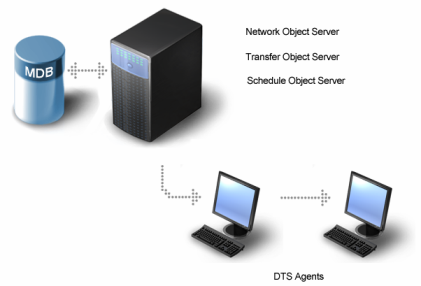
If a user has scheduled a transfer for a particular date and time. When that date and time arrive, the SOS recognizes that a transfer must occur, and tells the TOS to carry out the transfer. The TOS, upon receiving this request, instructs the initiating agent to transfer the data.
To achieve the levels of functionality, management, control, and flexibility that a mission-critical, enterprise-wide data transport solution demands, DTS uses a well structured object model. By creating instances of objects, setting properties, and calling methods, you can take full advantage of the powerful features of DTS.
|
Copyright © 2014 CA Technologies.
All rights reserved.
|
|