

To know how you initiate a data transfer, how you use the object model, and the role each of the individual DTS components plays, a typical DTS scenario follows:
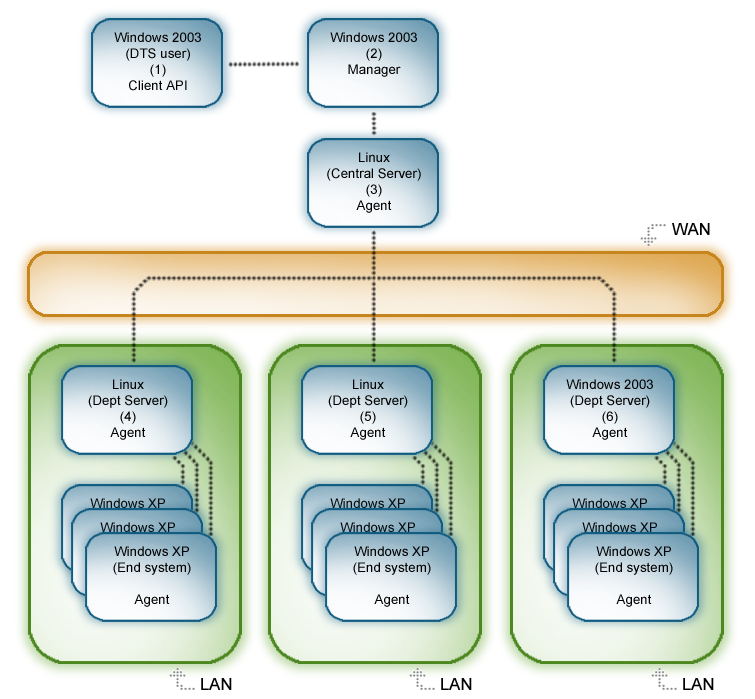
If a DTS administrator wants to perform a set of data transfers at 10:00 p.m. each week night. A large binary data file residing on a Linux server machine must be transferred to numerous Windows XP computers, which are spread across three separate local area networks (LANs). Each LAN has a departmental file server connected to it. The central server connects to the LANs through a comparatively low-bandwidth-wide area network (WAN). The departmental servers run Windows 2003 and Linux operating systems. Also, because of its sensitive nature, the data file is encrypted during its transfer.
As shown in the previous diagram, only the client API is installed on the DTS user computer (1). The DTS manager is installed on a separate Windows 2003 computer (2) and the DTS agent is installed on the central server (3), the departmental servers (4, 5 and 6) and all of the end systems, for a total of 300 end systems, if there are 100 end systems on each LAN.
The Windows 2003 manager machine (2) can also have CA Common Services installed; if so, it is responsible for all network, data transfer, and scheduling tasks.
|
Copyright © 2014 CA Technologies.
All rights reserved.
|
|