

|
|
|
A Loading Pattern defines how work is spread across the duation of a task. A resource's loading pattern defines how resource assignments are used to complete tasks when you recalcuate task duration and autoschedule your project. There are five patterns available to best help replicate how team members work on tasks.
You can assign resources to tasks using any of five loading patterns: Uniform, Contour, Fixed, Front, or Back. When you use these loading patterns in conjunction with Autoschedule, you can automatically produce a workable schedule that allows for real-world variations in the way work is assigned and completed.
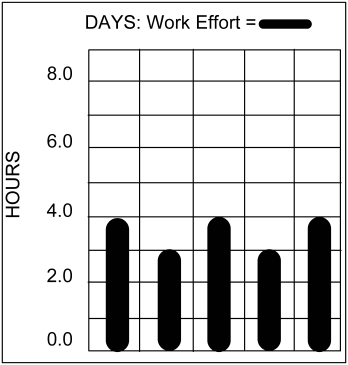
The Uniform loading pattern assigns resource time evenly across a task only on those days when the resource is available to meet the task requirements. For example, if a resource is scheduled to work four hours per day on a task, the resource will not be scheduled to work on that task on days when the resource is only available to work on the task for three hours. The maximum percentage and resource availability is taken into account when assigning resources to tasks using this loading pattern.
Note: To use this loading pattern, you must set the resource's maximum percentage on the task.
Graphically, this loading pattern can look like this:
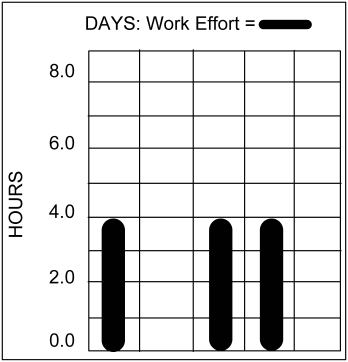
Front Loading Pattern
The Front loading pattern allocates resource usage as early in the task as possible. Resources are assigned to get work done as early as their availability permits. The resource's maximum percentage on a task and resource availability are taken into account when assigning resources to tasks using this loading pattern.
Note: To use this loading pattern, you must set the resource's maximum percentage on the task.
Graphically, this loading pattern can look like this:
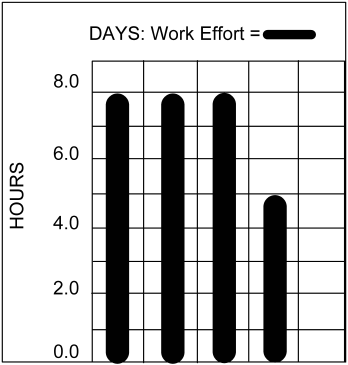
The Back loading pattern allocates resource usage as late as possible in the task. Resources are assigned to get work done as late as their availability permits. The Max % and resource availability is taken into account when assigning resources to tasks using this loading pattern.
Note: To use this loading pattern, you must set the resource's maximum percentage on the task.
Graphically, this loading pattern can look like this:
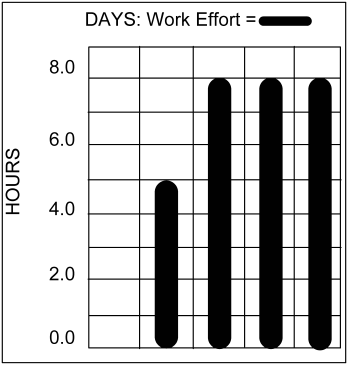
This Fixed loading pattern allocates resource usage to tasks according to your needs. Open Workbench automatically locks fixed resource assignments so that they are not changed when you autoschedule or when you recalculate task duration.
When you use this loading pattern, you can create a discontinuous task, or one that starts and stops, and then starts again. You can display the pattern in views where ETC is tabulated.
Graphically, this loading pattern can look like this:
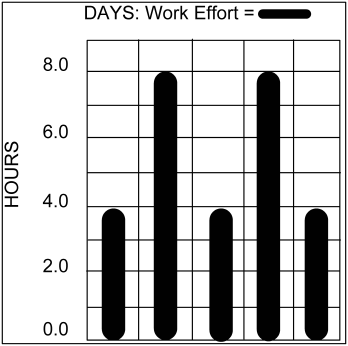
The Contour loading pattern fits resource loading around the resource's remaining availability, smoothing out the peaks and valleys. It is a very flexible loading pattern; it can appear as the reverse or mirror image of overlapping task patterns.
If a task's duration, start date, or finish date changes, or if you autoschedule the task or enter new ETC values, this pattern assumes the characteristics of the Uniform loading pattern. The changes you make to the duration of a task after it is scheduled causes resource assignments for each period to even out across the duration of the task.
Graphically, this loading pattern can look like this:
| Copyright © 2011 CA. All rights reserved. |
|