

The following diagrams provide an overview of the CA Chorus for Security and Compliance Management discipline architecture. After installation and setup, use it to manage security resources across your z/OS enterprise.
Observe the following:
To install and configure this discipline you must:
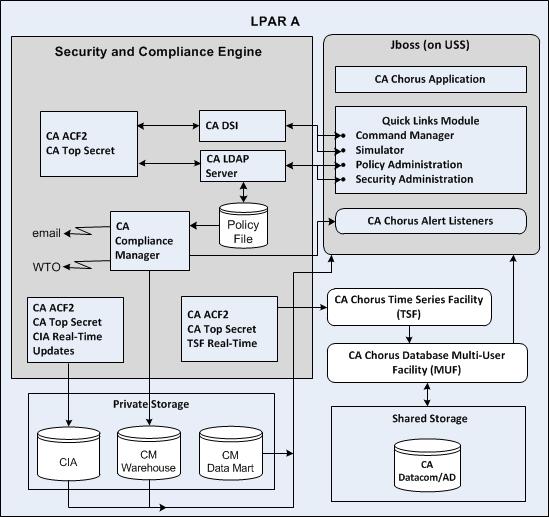
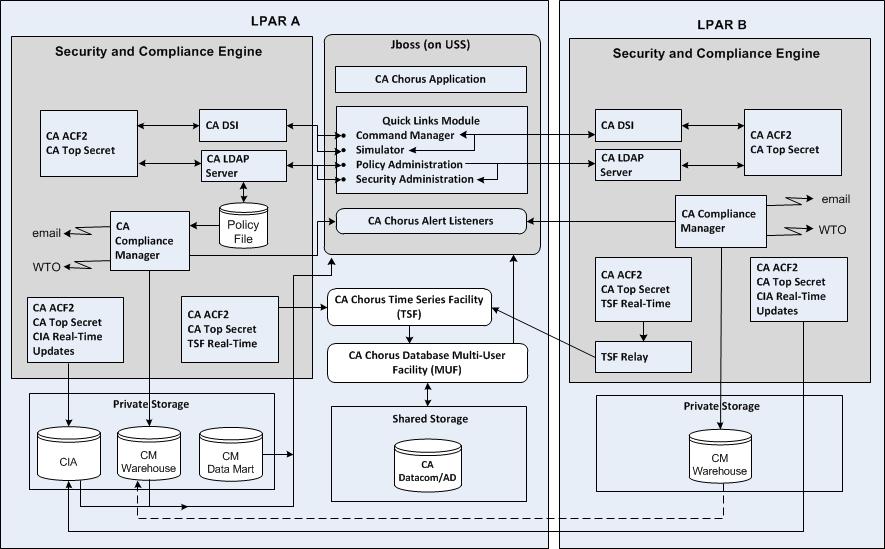
The diagrams illustrate the basic architecture:
Identify logical partitions of a mainframe (z/OS system), on which you execute your External Security Manager (ESM) as a back-end engine for this discipline. Multiple LPARs are supported.
Contains the CA Chorus system. Includes the following components:
Provides the browser support and components to communicate with the back-end engines for the various disciplines, such as the security engine.
For this discipline this module includes the Administer Compliance Policy, Administer Security Definitions, and Simulate Access Attempt interfaces.
Issues native commands to backend security engines from the CA Chorus interface.
Provides the service for receiving Alerts sent by the various backend security engines.
Provides the facility for receiving, storing, and querying metrics about objects managed by the security backend engines. Because all metrics are date- and time-stamped, a series can be graphed over time to show trends, and to project into the future.
Provides the infrastructure for storing and retrieving TSF.
Composite of the ESM and compliance products that together provide the input to this discipline. Includes but is not limited to CA ACF2, CA Top Secret, Compliance Policy Administration interface, and CA LDAP Server for z/OS.
Represents all storage devices that are shared across the CA Chorus disciplines.
Represents storage devices that are shared only across this discipline.
|
Copyright © 2013 CA Technologies.
All rights reserved.
|
|