

Implementing CIA Real-Time for CA Chorus for Security and Compliance Management › How CIA Real-Time Processing Works
How CIA Real-Time Processing Works
CIA real-time processing helps ensure that the information in the CIA repository is updated as changes occur to the security product database. When it is enabled, the CIA real-time feature performs the following actions:
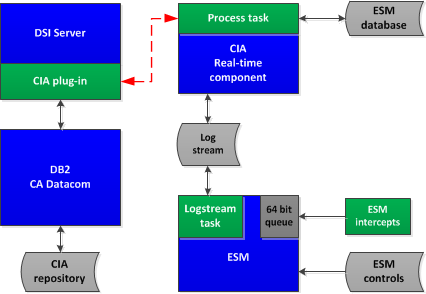
- A processing task in the security product address space removes the update requests from the request queue. The update request is written to a z/OS system logger logstream dedicated to the CIA real-time feature.
- A CIA real-time component reads the update requests from the CIA logstream. The component sends the request to a CA DSI Server running on the z/OS image where the CIA repository resides. When the CIA real-time feature is implemented, a CA DSI Server is required on the LPAR with the CIA repository. This CA DSI Server processes the CIA real-time requests, and updates the information in the CIA repository.
- A CIA real-time process in the CA DSI Server communicates the update requests to the DB2 or CA Datacom/AD subsystem where the CIA repository resides. The corresponding changes are made to the information in the CIA repository. The CA DSI Server communicates the results of the update request back to the CIA real-time component.
- If the update request was successfully processed into the CIA repository, the CIA real-time component deletes the update request from the CIA logstream.
- If the CIA real-time process was unable to complete due to a recoverable condition, the component stops processing, communicates the recoverable condition to the operator, and waits for resolution of the condition. The following are examples of these recoverable conditions:
- The CA DSI Server communication path through TCP/IP is unavailable
- The CA DSI Server is unavailable.
- The CA Datacom/AD MUF or DB2 subsystem in which the CIA repository resides is unavailable
- If a logical error was encountered trying to update the security information, the CIA real-time component records the error condition in a journal file (if one was supplied). The CIA real-time component then deletes the update request from the CIA logstream. These logical errors usually indicate that the request could not be processed because the security information in the CIA repository does not reflect the information in the security product database. Some examples of these logical errors are:
- The request is to add information that is already in the CIA repository.
- The request is to update information that does not exist in the CIA repository.
- The request is to delete information that does not exist in the CIA repository.
The following diagram illustrates the architecture of the CIA real-time process, and how the update requests flow from the security product to the CIA repository.
Copyright © 2014 CA Technologies.
All rights reserved.
|
|