

This case study examines the best practice methods for integrating with a file-based data source. The example scenario handles a CSV data file that is produced by the source system. With most file-based integrations CA recommends following some basic guidelines, to ensure minimal risk to the integration. These are as follows:
In this scenario, the source files are from a Topaz data source (now known as Mercury Global Monitor, owned by HP). This was created using an API of the product to include the required files for the specific KPIs required. The files are delivered to the CA Business Service Insight Application server directly by an external automated process. The source files are named: Topaz_yyyymmdd_hhmiss.csv.
Note: The timestamp of the file is the time at which it was created, hence all entries within the file are leading up to this time.
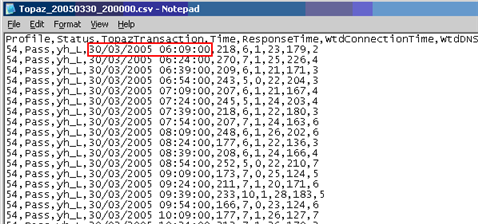
A sample of the data inside the file can be seen below.
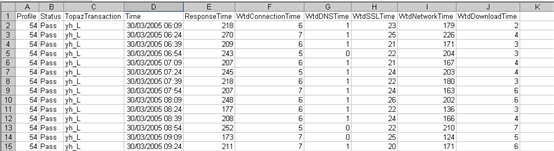
Note: CA recommends checking CSV files in Notepad (rather than just Excel) to ensure that the date format is as expected. Excel has a tendency to format the dates according to regional settings of the machine and may not match the actual format seen by the adapter.
Before commencing any adapter creation process, it is also critical that you have done all necessary analysis and investigation into the data source and related KPIs to ensure that the following are known:
Once these points are known, you can commence the creation process.
Now, we can perform the adapter creation process based upon this scenario, using the Adapter Wizard.
In our scenario we use the “TopazTransaction” as the resource, the “Profile” as the Event Type, and the “Time” field as the timestamp. We also bring the “Status”, “ResponseTime”, and “WtdDownloadTime” fields into the event structure for use with the business logic.
|
Copyright © 2012 CA.
All rights reserved.
|
|