

You can notify a person at any time of day or night through a page that conveys the specifics of an event. If the pager supports two-way communication, you can use the paging device to respond directly to the event that triggered the notification. Two-way paging lets you take advantage of wireless technology to better track the status of a page request, and to retrieve a response from a person who has the wireless device. These paging requests are transmitted over the Internet, instead of using a modem, letting you avoid telephone dialing delays. You can also handle a greater number of different paging service providers concurrently without adding additional modems. You can use a two-way paging utility to display the status of an outstanding two-way page request in real time.
If a one-way pager is used, the incoming telephone answer capabilities provided by the Notification Server can be used to remotely respond to the event.
CA Automation Point supports paging providers who follow the standards outlined by the Telocator Alphanumeric Protocol (TAP). Support for additional protocols is available with NMTAP, which supports sending multiple pages to a paging service with a single phone call, and TAPPAGE, which enables you to issue a TAP page directly from the command prompt without going through the NMFIND command (or using the Notification Manager database). REXX programming is required for both these protocols.
Note: For one-way paging, CA Automation Point supports controller-based hardware modems.
CA Automation Point supports two-way paging through both of the following protocols:
If the WCTP protocol is used, the paging service must support version 1.1 of this protocol. The VOX command processor, PAGE2WAY, lets you submit two-way page requests.
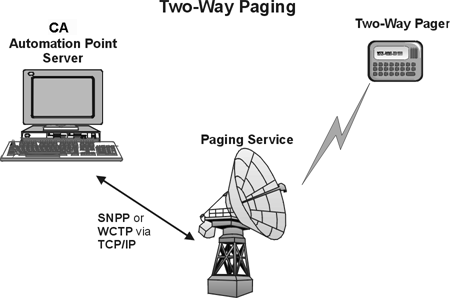
The following illustration shows how two-way paging works.
|
Copyright © 2014 CA Technologies.
All rights reserved.
|
|