

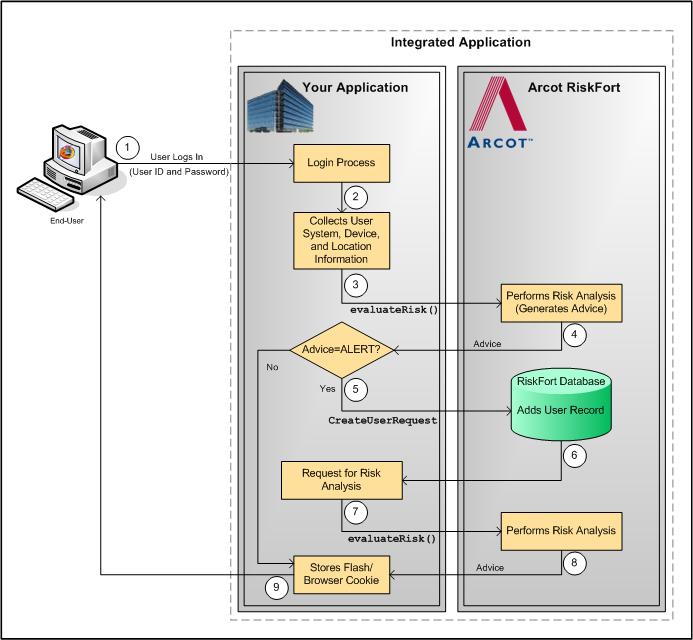
If you call the CreateUserRequest message after the evaluateRisk operation, the steps for the explicit enrollment workflow are:
Your system validates if the user exists in the system. If the user name is not valid, then your application must take appropriate action.
Your application collects the following information from the user’s system that will be used by RiskMinder for analyzing the risk:
Your application must call the evaluateRisk operation in RiskFortEvaluateRiskSvc. In this call, you must pass all the user and device information that you collected in Step 2 to RiskMinder.
RiskMinder performs risk analysis for the user and generates an advice. In this case, because the user is not yet "known" to the RiskMinder system, the ALERT advice is generated.
Your application must make an explicit call to the createUserRequest message in the ArcotUserRegistrySvc Web service. In this call, you must pass all relevant user details, such as the user’s first name, last name, organization, email, and their personal assurance message (PAM) to RiskMinder.
Book: See "Managing Users and Accounts" in the CA RiskMinder Web Services Developer’s Guide for detailed information about the createUserRequest message.
If the createUserRequest call was successful, then RiskMinder creates the user record in the RiskMinder database. With this, the user is enrolled with RiskMinder.
Your application must call the evaluateRisk operation in RiskFortEvaluateRiskSvc. In this call, you must ensure that you pass all the user and device information that you collected in Step 2 to RiskMinder.
In this case, RiskMinder executes the rules and generates the risk score and the advice.
Your application must store the Device ID returned by evaluateRisk as a cookie on the device that the end user is using for the current transaction.
The following figure illustrates the explicit enrollment workflow when you call the createUserRequest message before the evaluateRisk call.
|
Copyright © 2013 CA.
All rights reserved.
|
|