

To ensure integrity and confidentiality of the data being exchanged during a session, AuthMinder supports Secure Socket Layer (SSL) communication between Java SDKs and AuthMinder Server. By default, the communication mode between all the components is through Transmission Control Protocol (TCP).
The following figure shows the communication that are supported between AuthMinder components:
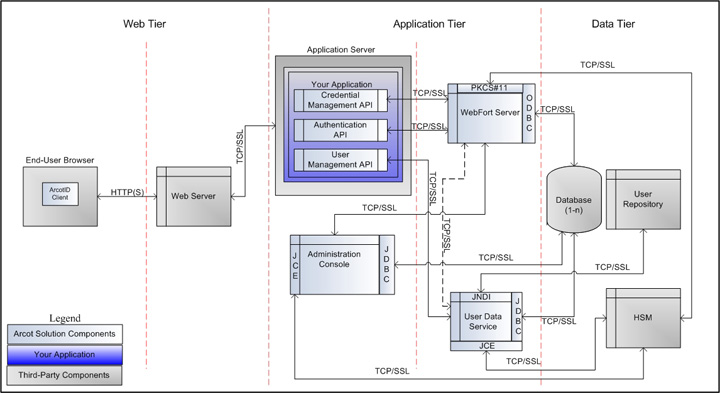
Important! Before you enable SSL communication between Java SDKs and AuthMinder Server, you must obtain a digital certificate from a trusted Certificate Authority and expose your application over an HTTPS-enabled server port.
To set up one-way SSL between Java SDKs (Authentication and Issuance) and AuthMinder Server, you must first configure the Transaction Native protocol by using the Protocol Management page of the Administration Console and then configure the webfort.authentication.properties and webfort.issuance.properties files.
In case of two-way SSL, you must create the client store using the Trusted Certificates Authorities page, configure the client store using the Protocol Management (Transaction Native) page, configure the client certificates using the WebFort Connectivity (Transaction Native) page of the Administration Console, and then configure the webfort.authentication.properties and webfort.issuance.properties files.
Note: If you want to enable SSL between Administration Web Service and AuthMinder Server, then you need to follow the steps mentioned in this section.
The following subsections walk you through the detailed steps for configuring:
Note: In this communication, your application integrated with the Java SDKs is the client and AuthMinder Server is the server.
|
Copyright © 2013 CA.
All rights reserved.
|
|