

Retransmission Delay is the additional delay in the Network Round Trip Time caused by packets needing retransmission. The following example view shows that retransmissions over the WAN for this HTTP application cease when WAN-optimization is active.
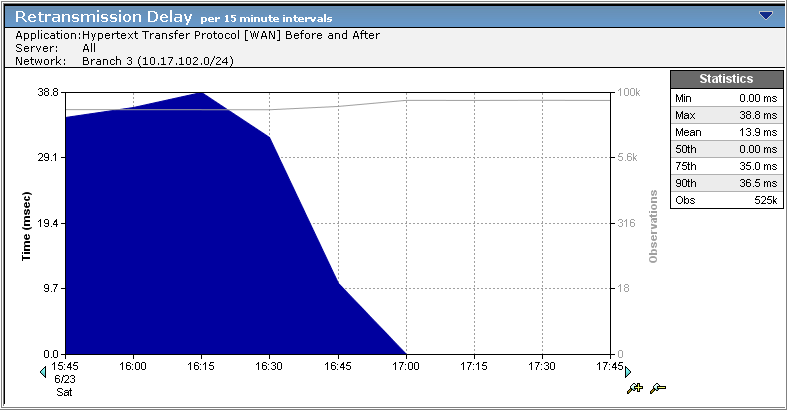
The data is an average across all observations, not the actual retransmission time for one transaction. Given a total of five transactions, four with no retransmissions, and one with a 5-second Retransmission Delay, the view displays a 1-second Retransmission Delay.
Retransmission Delay is calculated by observing duplicate packets within the network from its vantage point next to the server. The monitoring device can see packets retransmitted by the server because of data losses in the server-to-client direction along the network path. These observations are included in the Retransmission Delay. When data loss occurs in the client-to-server direction (in the network path before reaching the server, for example), the monitoring device cannot observe such packet loss and that delay is not included in the Retransmission Delay metric.
The management console includes this retransmission delay in the Network Round Trip Time metric, which includes the server response and client acknowledgment; therefore, it is a delay in client acknowledgment caused by unseen Retransmission Delay that increases the Network Round Trip Time value. This metric does not reveal the impact of losses on the Data Transfer Time because of TCP congestion.
Retransmissions can cause a given session to reduce the transaction time, but the speed of the bytes across the line remains constant unless the path changes or congestion increases.
|
Copyright © 2015 CA Technologies.
All rights reserved.
|
|