

z/OS service end point (gateway) appliances enable TCP/IP connectivity from software running in appliances on an CA AppLogic® for System z grid to a z/OS subsystem such as:
Note: The methodology of using the service end point appliance has been accredited on, but is not limited to, these subsystems.
You can use many methods to connect to a z/OS subsystem using TCP/IP, but providing specific configuration templates for each of these methods is impractical. The described process uses an open-ended approach. The process helps you decide which properties to include for each type of service end point appliance, depending on the connection method.
You can provide the connectivity information in one of the following ways:
At a minimum, the service_host and service_port properties must be configured. This section describes how to use properties to provide the connectivity information. Providing this information involves the following components:
The following example shows how appliances are connected to create an application that connects to CA Datacom:

This section contains the following topics:
How the Subsystem Connection Process Works
Management has a business requirement for applications in CA AppLogic® for System z to communicate with z/OS subsystems. This requirement is communicated to the z/OS system administrator, application developer, and operator.
As a z/OS system administrator, you create z/OS service end point appliances to enable application appliances to connect to the required subsystems. As an application developer, you require a service end point that contains information for your application to communicate with a z/OS subsystem. As an operator, you configure the z/OS service end point administration environment to facilitate the z/OS system administrator to create the end point appliances.
The following illustration provides an overview of the process:
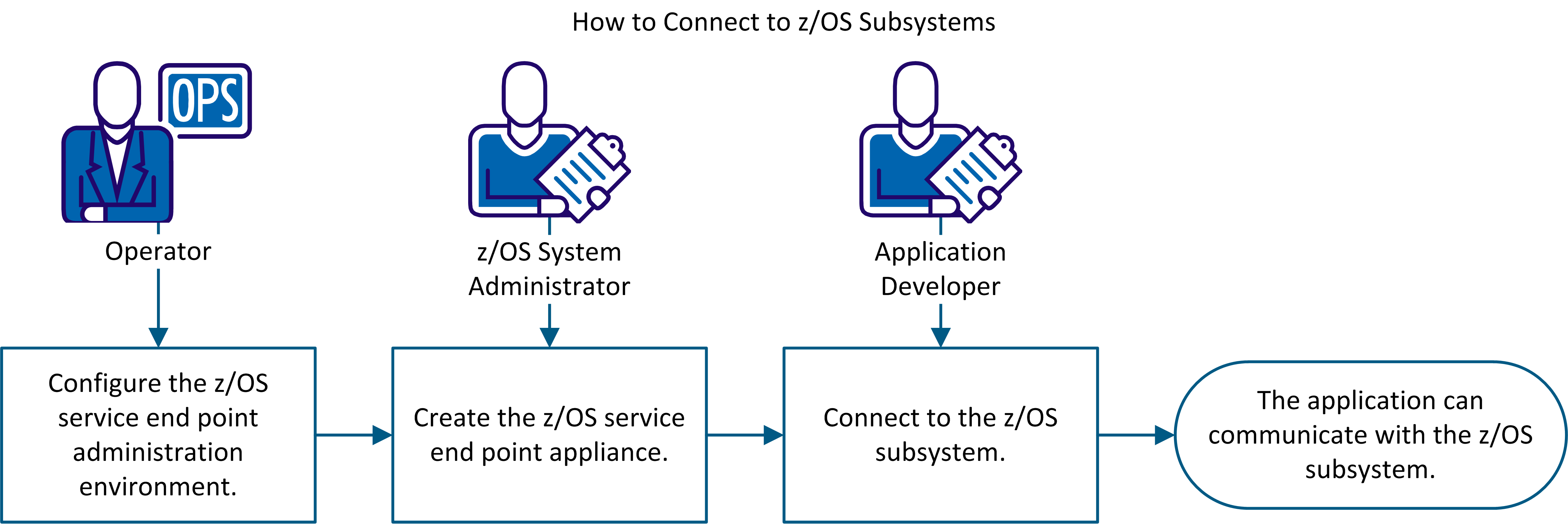
The process has the following tasks:
The operator performs this task once per grid. After the environment is set up, authorized users can create service end point appliances.
The administrator creates service end point types and use those types to create end point appliances for specific subsystems.
The developer customizes the application code and connects the application appliance to the end point appliance to create the CA AppLogic® for System z application.
Generic_svcpt_type is a generic service end point type in the system catalog. This generic type forms the basis for creating other service end point types. This component has two predefined properties, service_host and service_port. When you create the service end point, these properties enable you to locate the subsystem that you want to connect.
A service end point type defines the connectivity properties that are based on the type of subsystems and the connection method. For example, the properties for connecting to a CA Datacom subsystem and to a DB2 subsystem are different.
If you connect to CA IDMS, CA Datacom, DB2, and IMS using the JDBC Type 4 driver, define four different service end point types. Each type contains the name of their respective properties that are based on the subsystem to which you want to connect.
For example, for connection to a CA Datacom subsystem, create a type and add the following properties to the already supplied properties of service_host and service_port: applicationID, serverName, systemID, and planName. You have a service end point type for CA Datacom connection using the JDBC Type 4 driver.
For connection to a DB2 subsystem, create a type and add the following properties to the already supplied properties of service_host and service_port: location, userID, and password. You have a service end point type for DB2 connection using the JDBC Type 4 driver.
If you connect to these subsystems using other methods, then you create types with the required properties for the method you use. For example, you can create types for connections using the JDBC Type 2 driver.
A service end point is the actual appliance that provides the connectivity information between the application running on the grid and the requested z/OS subsystem.
Using the appropriate service end point type, you create the end point for connecting to a particular subsystem.
Example: Service End Point for CA Datacom
This example shows the properties values you specify when creating the service end point for a particular CA Datacom subsystem:
This service end point has all the necessary connectivity information for the connection to the subsystem through a JDBC Type 4 driver.
The following user roles create service end point appliances that connect to a z/OS subsystem and exploit that connectivity in an application:
Creates the application appliances that connect to z/OS subsystems and is familiar with the existing applications that require communication with those subsystems.
Provisions and operates applications on the grid. Operators can also add and remove other grid users.
Knows the target subsystems available on z/OS and the parameters that are required to establish a connection to these subsystems.
|
Copyright © 2013 CA.
All rights reserved.
|
|