

|
At a Glance |
|
|
Catalog |
System |
|
Category |
Generic |
|
User volumes |
no |
|
Min. memory |
96 MB |
|
OS |
Linux |
|
Constraints |
no |
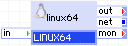
LINUX64 is a general server appliance. You can branch the appliance to make new server appliances: singletons or server classes.
The appliance includes a reasonably complete installation of its OS, including the GCC compiler if available. This allows installing and building software on the branched appliances.
The generic server appliance is designed to be used in two ways:
Here server means virtual server. Virtual servers are similar to appliances in all aspects except intent (virtual servers are made to be logged into for the installation of additional software) and volume size (much bigger than appliance's volumes).
Note: If you do not need GCC and the ability to build on the server appliance, consider using the LUX64 generic appliance template instead of LINUX64.
|
Name |
Latest Version |
OS |
|
LINUX64 |
3.0.1-1 |
CentOS 6.2 (64 bits) |
Resources
LINUX64
|
Resource |
Minimum |
Maximum |
Default |
|
CPU |
0.05 |
16 |
0.25 |
|
Memory |
96 MB |
32 GB |
512 MB |
|
Bandwidth |
1 Mbps |
2 Gbps |
100 Mbps |
Terminals
|
Name |
Dir |
Protocol |
Description |
|
in |
in |
Any |
Generic input |
|
out |
out |
Any |
Generic output for a single host |
|
net |
out |
Any |
Generic output for subnet access |
|
mon |
out |
CCE |
Sends performance and resource usage statistics. |
Notes:
Volumes
Servers have only a boot volume (instantiable class volume). There are no placeholder volumes (although when you branch this class to create a customized server, you can add a placeholder volume).
Notes
Open source and third-party software used inside of the appliance
LINUX64 uses the open source and third-party packages in its base OS install of CentOS 6.2.
|
Copyright © 2013 CA.
All rights reserved.
|
|